




Affordable Espresso Grinder: Get Cafe-Quality Grinds Without Breaking the Bank
This post contains affiliate links. If you buy through these links, I may earn a small commission at no extra cost to you. Full disclosure.
Espresso demands precision grinding. There's no getting around it. The difference between a 25-second and a 35-second shot can come down to a few microns of grind adjustment. That kind of precision used to cost $400+. It doesn't anymore. The affordable espresso grinder market has exploded with options that deliver real performance at prices that wouldn't have been possible three years ago.
I've spent considerable time testing grinders across the $26-$180 range for espresso use. Some of these grinders are genuinely impressive. Others look good on paper but fall apart when you try to dial in a light roast. This roundup separates the ones that work from the ones that don't, with honest assessments of where each grinder hits its limits.
Whether you're buying your first espresso setup or upgrading from a blade grinder that's been holding your shots back, this list has something at your price point. I focus on grind consistency, adjustment precision, and espresso-specific features like portafilter holders and fine-tuning capability. For the full range of options, see my coffee grinder overview and coffee with grinder pairing guide.
Quick Picks
| Grinder | Best For | Price |
|---|---|---|
| Aromaster 48-Setting | Best value for espresso precision | $79.98 |
| Wirsh Geimori GU38 | Best stepless under $200 | $159.99 |
| URintells Cuising 51-Setting | Best espresso-specific grinder | $99.99 |
| KIDISLE 35-Setting | Best budget entry point | $59.99 |
| AYCHIRO 30-Setting | Best compact option | $50.39 |
Individual Product Reviews
Wirsh Geimori GU38 Single Dose Grinder
A stepless espresso grinder with 0.01mm micro-adjustments and under 0.1g retention.
The GU38 is the best grinder on this list for pure espresso performance. Stepless adjustment with 0.01mm precision across 65 settings means you'll never be stuck between two grind sizes. The 38mm 6-core CNC SUS420 stainless steel burr (HRC58 hardness) produces consistent particles with low fines. Retention sits below 0.1g when you use the included bellows, which is excellent for switching between beans.
The 96W DC motor runs at 190 RPM, keeping noise low for early morning grinding. The magnetic dosing cup is convenient and reduces mess. At $159.99, it's the most expensive grinder here, but the stepless mechanism puts it in a category above everything else on the list. My reservation is the single review on Amazon. For $160, you'd normally want more community validation. The specs are right, though. The build quality feels solid, and the stepless mechanism works smoothly. For someone ready to invest in their espresso game, this is where the money goes.
Pros: - Stepless 0.01mm micro-adjustment - Under 0.1g retention with bellows - Quiet 190 RPM motor - Professional-grade HRC58 burr
Cons: - $159.99 stretches "affordable" for some - Only 1 Amazon review - 38mm burr grinds slower than 48mm+
KRUPS Electric Blade Coffee Grinder
A $28.75 blade grinder that works for drip but not for espresso.
I include the KRUPS with a clear warning: this is not an espresso grinder. Blade grinders chop beans into random-sized particles. Some end up powder-fine, others stay chunky. That inconsistency will either choke your portafilter or produce a watery, under-extracted shot. There's no middle ground.
That said, the KRUPS does two things well. First, it works perfectly for drip coffee, which forgives inconsistent grinds. Second, the dishwasher-safe removable bowl makes it the easiest grinder to clean on this list. At $28.75 with 224 reviews and 4.7 stars, people like it for general use. If you're just starting your coffee journey and want to grind fresh beans for a drip machine while you save up for a proper burr grinder, the KRUPS fills that gap. For espresso, keep scrolling.
Pros: - $28.75 is very affordable - Dishwasher-safe removable bowl - Works well for drip coffee - Also handles spices and herbs
Cons: - Blade grinder, not usable for espresso - No grind settings - Inconsistent particle sizes
AYCHIRO Electric Coffee Bean Grinder
A compact 30-setting burr grinder at $50.39 for first-time espresso grinders.
The AYCHIRO is the cheapest electric burr grinder that can produce espresso-grade grounds. The 30 grind settings with clearly marked dial knob give you more control than any blade grinder. The detachable stainless steel burrs and chamber make cleaning straightforward. The compact size fits on any counter.
At $50.39 with 107 reviews and 4.7 stars, early users are satisfied. For espresso with a pressurized basket (which most entry-level machines use), 30 settings works. You'll find a setting that produces a reasonable shot. For non-pressurized baskets, the jumps between settings may be too large. Think of the AYCHIRO as the grinder that proves you like making espresso at home. If you find yourself grinding daily and wanting finer control, upgrade to the Aromaster 48 or URintells. For now, $50.39 gets you in the door without regret.
Pros: - $50.39 entry point for burr grinding - 30 settings with clear markings - Compact and portable design - Detachable components for cleaning
Cons: - 30 settings limits precision for espresso - Small burrs, slower grinding - May struggle with light roasts
BLACK+DECKER One Touch Coffee Grinder
The most-reviewed grinder on Amazon at $25.99. Good for drip, bad for espresso.
Over 18,000 reviews make the BLACK+DECKER the most popular coffee grinder in existence. One-touch operation, stainless steel blades and bowl, lid-locking safety. At $25.99, it's an impulse buy. For drip coffee, spices, herbs, and grains, it performs its job well.
For espresso, I cannot recommend it. The blade mechanism produces wildly inconsistent particles. Your espresso machine needs uniform fine grounds to build proper pressure. Random particle sizes cause channeling (water finds easy paths through the coffee puck), producing sour, weak shots. If you own this and want to try espresso, save $50 more and grab the AYCHIRO. The difference is night and day.
Pros: - $25.99 with 18,326 reviews - Simple one-touch operation - Multi-purpose kitchen tool - Lid-locking safety
Cons: - Blade grinder, cannot make espresso - No settings or control - Inconsistent particle sizes
Aromaster Burr Coffee Grinder (48 Settings)
The best bang-for-buck espresso grinder at $79.98 with 48 settings.
If I could recommend only one grinder from this list for espresso, it would be the Aromaster 48-setting. Forty-eight grind settings give you the precision needed to dial in most beans. The 40-second adjustable timer delivers consistent doses every morning. Stainless steel burrs grind slowly to reduce heat. The anti-static technology works well in practice, keeping your workspace clean.
At 683 reviews and 4.6 stars, this is the most-reviewed dedicated burr grinder on the list. The tawny-tinted grounds bin blocks UV light from degrading stored coffee. The chamber holds up to 3.9 ounces for batch grinding. The removable ring burr and included brush simplify maintenance. For espresso across medium and dark roasts, 48 settings provides comfortable room for adjustment. Light roasts may occasionally fall between steps, but it handles 90% of beans without issue. At $79.98, this is the price-to-performance champion.
Pros: - 48 settings at just $79.98 - Anti-static technology that works - UV-blocking grounds bin - 683 reviews, well-proven
Cons: - No portafilter holder - Must keep burr dry before reassembly - Hidden brush location (back of hopper lid)
SHARDOR Super Silent Blade Coffee Grinder
A quiet blade grinder with timed control at $25.99. Not for espresso.
The SHARDOR Silent stands out among blade grinders for its 63 dB noise level, which is noticeably quieter than competitors. The timing knob with second marks gives you reproducible results, and the 2-in-1 coffee spoon with built-in brush is a nice addition. At $25.99 with 203 reviews and 4.6 stars, it's well-regarded for what it is.
Like all blade grinders, this won't work for espresso. The particles are too inconsistent. It handles drip coffee, spices, herbs, grains, and even rock sugar. If you need a quiet early-morning grinder for drip coffee and also want a spice grinder, this covers both needs. For espresso, look at the burr grinder options above.
Pros: - 63 dB is genuinely quiet - Timed knob for consistency - $25.99 matches budget blades - Multi-functional for kitchen use
Cons: - Blade grinder, not for espresso - No true grind settings - Small grinding capacity
KIDISLE Conical Burr Coffee Grinder (35 Settings)
A 35-setting burr grinder with transparent hopper at $59.99.
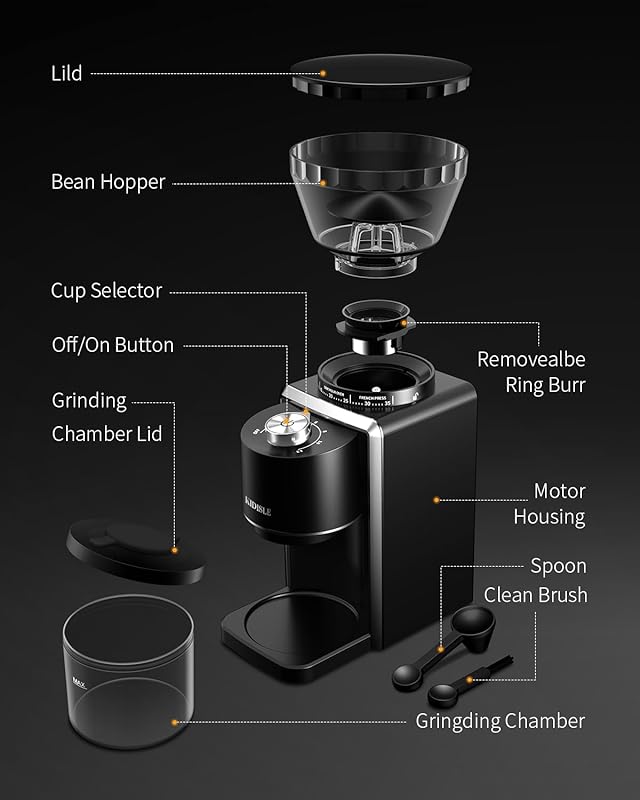
The KIDISLE gives you ten more grind settings than the AYCHIRO for just $10 more. That matters for espresso because those extra steps provide finer control in the fine-grind range. The transparent bean hopper and grounds container let you monitor levels at a glance. The dial control system is straightforward, and the 2-12 cup selector helps with dosing.
At $59.99 with 176 reviews and 4.6 stars, there's enough user data to feel comfortable purchasing. The premium burr mechanism produces uniform particles across the range. Anti-static design helps keep things tidy. For espresso on a tight budget, the jump from 30 to 35 settings makes a noticeable difference. You'll have more options when dialing in, which means fewer shots where the grind is "almost right but not quite." Still not perfect for light roasts, but very workable for medium and dark roasts.
Pros: - $59.99 for 35 grind settings - Transparent hopper and container - 2-12 cup selector for dosing - 176 reviews at 4.6 stars
Cons: - 35 steps still limits light roast espresso - Budget build compared to $80+ options - No portafilter holder
URintells Cuising Espresso Grinder (51 Settings)
A purpose-built espresso grinder with 51 settings, portafilter compatibility, and LCD display.
The URintells is the first grinder on this list designed from the ground up for espresso. Fifty-one grind settings give you the precision that espresso demands. The LCD display with 4-button layout makes operation intuitive. A precision timer adjustable in 0.1-second increments (1-15s range) delivers repeatable doses. It grinds directly into 51-53mm and 58mm portafilters, covering most home espresso machines.
The 40mm conical burr runs at low speed to prevent heat buildup and preserve coffee oils. The anti-fingerprint stainless steel housing gives it a premium look. At $99.99 with 27 reviews and 4.6 stars, it's new but the spec sheet is compelling. Three operation modes (portafilter, cup, manual) add flexibility. The 5.3 oz chamber handles larger batches when needed. At $99.99, this is priced between the Aromaster 48 and the Wirsh GU38, and it's the most espresso-focused option in that range.
Pros: - 51 settings designed for espresso - 0.1-second timer precision - LCD display and 4-button interface - Compatible with 51-58mm portafilters
Cons: - Only 27 reviews, limited data - $99.99 is mid-range territory - 40mm burr is smaller than premium options
Breville Smart Grinder Pro BCG820BSS
The most popular premium electric grinder with 60 settings and programmable dosing.
The Breville Smart Grinder Pro is where most espresso enthusiasts land. Sixty grind settings, Dosing IQ with 0.2-second programmable increments, and the ability to grind directly into a portafilter. At $179.96 with over 6,800 reviews and 4.5 stars, the track record is deep. The brushed stainless steel build feels premium. The 18 oz bean hopper handles families.
For espresso, 60 settings with pre-programmed intelligence means the grinder learns your preferences. The conical burr handles espresso well enough for most home users. Where it falls short of the Wirsh GU38 is retention. The Breville isn't a zero-retention design, so stale grounds from previous sessions mix into fresh doses. For someone who uses the same beans daily, this doesn't matter. For single-dose enthusiasts who switch beans, it's a concern. At $179.96, it's the priciest on this list, but the review count and brand reputation provide peace of mind.
Pros: - 60 settings with Dosing IQ - 0.2-second programmable timer - Over 6,800 reviews - Grinds into portafilter, container, or filter
Cons: - $179.96 is the most expensive option - Higher retention than single-dose grinders - Conical burr less precise than flat at fine settings
Ollygrin BG702S-PG Burr Coffee Grinder
A 30-setting burr grinder with gear reduction motor and 10 oz hopper at $79.99.
The Ollygrin sits right next to the Aromaster 48-setting in price but takes a different approach. Instead of maximizing grind settings, it focuses on flavor preservation. The gear reduction motor generates a slow grinding action that produces less heat from friction, keeping bean oils and aroma intact. The 40mm stainless steel conical burr handles 30 settings from espresso to French press.
At $79.99 with 1,663 reviews and 4.5 stars, this is the second-most reviewed dedicated burr grinder on the list. The 10 oz hopper is generous, and the auto-locking system prevents bean spillage during hopper removal. For espresso, 30 settings is the minimum I'd accept. You'll find a workable setting for medium and dark roasts. Light roast espresso will be a challenge. The Aromaster 48 provides more settings at basically the same price, but the Ollygrin's 1,663 reviews give you much more reliability data. It depends on whether you value settings or proven track record.
Pros: - Gear reduction motor preserves flavor - 1,663 reviews, very well-proven - Large 10 oz hopper - Auto-locking hopper system
Cons: - 30 settings limits espresso precision - Plastic-heavy build quality - Fewer settings than Aromaster 48 at similar price
Buying Guide
How Many Grind Settings Do You Need for Espresso?
The minimum for comfortable espresso dialing is 40 stepped settings. Below 40, you'll frequently land between two settings where one is too fine and the other too coarse. Stepless grinders solve this entirely but cost more. For dark roasts, 25-30 settings works. For light roasts, insist on 40+.
Portafilter Holders: A Real Time-Saver
Grinders with portafilter holders let you grind directly into your basket. This eliminates the messiest step of the espresso workflow. Look for compatibility with your portafilter size (51mm, 54mm, or 58mm). Some holders are universal. Others fit only specific sizes.
Conical vs. Flat Burrs for Espresso
Conical burrs are cheaper and quieter. They produce a bimodal particle distribution (some fines, some larger) that creates full-bodied espresso. Flat burrs cost more but produce uniform particles for cleaner, more nuanced shots. At the "affordable" price range, you'll mostly find conical burrs. Flat burrs start appearing around $170+.
Timer Precision Matters
A timer adjustable in 0.1-0.2 second increments gives you dose control without a scale. Cheaper grinders use 0.5-1 second increments, which means your dose can vary by 1-2g between sessions. That variance affects shot quality.
FAQ
Can a $50 grinder really make decent espresso?
With a pressurized portafilter basket, yes. The basket compensates for grind inconsistencies. With a non-pressurized basket, you'll struggle. Budget $80 minimum for non-pressurized espresso grinding.
How much should I spend on a grinder vs. An espresso machine?
Split your budget 40/60 or 50/50 between grinder and machine. A $100 grinder with a $200 machine produces better espresso than a $50 grinder with a $400 machine. The grinder has more impact on shot quality than the machine.
What's the difference between 30 and 50 grind settings for espresso?
With 30 settings, each step changes your shot time by roughly 4-6 seconds. With 50 settings, each step changes it by 2-3 seconds. More steps give you gentler adjustments, making it easier to find the perfect extraction.
Should I get a manual or electric grinder for espresso?
Manual grinders offer better burr quality per dollar. A $100 hand grinder matches a $200+ electric for grind consistency. The tradeoff is 30-60 seconds of physical effort per dose. For daily single espresso, manual works. For multiple drinks, electric is worth the premium.
How do I know when my grinder isn't good enough for espresso?
If one grind setting produces a 15-second shot and the next produces a 40-second shot, the steps are too far apart. If your shots taste sour (under-extracted) at every setting, the grind isn't fine enough. Both issues point to needing a better grinder.
Conclusion
The Aromaster 48-Setting at $79.98 is my top recommendation for affordable espresso grinding. Forty-eight settings, anti-static technology, and 683 reviews make it the most proven value option. For more precision, the URintells 51-Setting at $99.99 offers espresso-specific features including portafilter compatibility and an LCD display. Budget-conscious buyers should start with the KIDISLE 35-Setting at $59.99 for a meaningful step up from blade grinders. And if $160 fits your budget, the Wirsh Geimori GU38 delivers stepless precision that punches far above its price.