


Best Affordable Espresso Grinder: 10 Options Under $250 for 2025
This post contains affiliate links. If you buy through these links, I may earn a small commission at no extra cost to you. This helps support Coffee Grinder Guide and keeps our reviews independent.
Pulling great espresso at home doesn't require a $500 grinder. I know that sounds like something every affiliate site says, but after months of testing grinders under $250, I genuinely believe the affordable segment has gotten strong enough to satisfy most home baristas. The technology that used to be exclusive to premium grinders has trickled down. Flat burrs, stepless adjustment, electronic timers, and anti-static systems are now available at prices that would have been unthinkable five years ago.
This guide is for the home barista who wants to invest wisely. You've already committed to an espresso machine, and now you need a grinder that won't be the weak link in your setup. I tested each grinder with the same beans on the same machine, evaluating grind uniformity, fine-end precision, retention, static, and overall shot quality.
Whether you own a coffee grinder already and want to upgrade for espresso, or you're buying your first dedicated espresso grinder, this list covers the best options from $25 to $250. Some are genuine performers. Others are budget compromises. I'll be direct about which is which.
Quick Picks
| Grinder | Best For | Price |
|---|---|---|
| SHARDOR 64mm Flat Burr | Best Affordable Flat Burr | $169.99 |
| Aromaster 25-Setting | Best Under $75 | $69.99 |
| Breville Smart Grinder Pro | Best All-Around Under $200 | $179.96 |
| KIDISLE 35-Setting | Best Beginner-Friendly | $59.99 |
| SHARDOR 64mm Premium | Best Semi-Pro Under $250 | $249.99 |
Individual Product Reviews
Aromaster Conical Burr Coffee Grinder (25 Settings)
At $69.99, the Aromaster is where affordable espresso grinding starts to get real.
The portafilter holder is the feature that earns this grinder its spot. Being able to grind directly into a 51-53mm portafilter streamlines the espresso workflow and reduces mess. Twenty-five settings provide enough fine-end resolution for pressurized baskets, and the 2-12 cup timer gives you repeatable doses.
The DC motor runs quiet enough for apartment living, and the tool-free disassembly makes cleaning straightforward. At this price, the Aromaster outperforms most grinders in the $50-$80 range for espresso specifically because of the portafilter compatibility.
The fine end could be finer. For unpressurized baskets with light roasts, you may find yourself wishing for more precision below the finest setting. Dark and medium roasts work better here, as they require a slightly coarser espresso grind.
Pros: - Portafilter holder (51-53mm 3-ear) - Quiet DC motor - 25 settings with cup timer - $69.99 is accessible
Cons: - Fine end may not go fine enough for light roasts - Limited to 51-53mm 3-ear portafilters - 24 reviews
KRUPS Electric Blade Coffee Grinder
Let me level with you. A blade grinder for espresso is like using a kitchen knife to cut sushi. You can technically do it, but the results won't impress anyone.
The KRUPS at $28.75 grinds coffee beans into particles of wildly varying sizes. For espresso, this means some grounds over-extract while others under-extract. The result is a shot that tastes muddled rather than clean.
That said, paired with a pressurized portafilter basket and the patience to pulse-grind and shake, the KRUPS can produce something resembling espresso. The dishwasher-safe removable bowl and versatile spice-grinding capability add practical value beyond coffee with grinder needs. But make no mistake: this is the compromise option, not the recommended one.
Pros: - $28.75 price point - Dishwasher-safe bowl - Versatile for spices - Simple operation
Cons: - Blade grinding is fundamentally wrong for espresso - Wildly inconsistent particle sizes - No grind control - Requires extensive technique
BLACK+DECKER One Touch Coffee Grinder
Another blade grinder that I include for completeness. At $25.99 with 18,326 reviews, it's the proven reliability champion of budget grinding.
For espresso, the same limitations as the KRUPS apply. Blade grinding doesn't produce the uniformity espresso extraction demands. The lid-locking safety feature and stainless steel construction are practical pluses, and the one-touch operation is as simple as it gets.
Use this if you already own it and want to experiment with espresso. Don't buy it specifically for espresso when the Aromaster at $69.99 is a dramatically better investment for that purpose.
Pros: - $25.99 with massive review validation - Proven reliability - Safety features - Simple one-touch operation
Cons: - Blade grinding is unsuitable for espresso - No grind adjustments - Small 2/3 cup capacity - Will require pressurized basket
Hamilton Beach Custom Grind (80406)
The Hamilton Beach adds adjustable grind selection to the blade format, which helps slightly for espresso. But it's still a blade grinder at its core.
At $37.99, the selection ring targets finer grinds more reliably than pure push-button models. The auto-shutoff saves time, and the removable bowl cleans easily. For someone brewing espresso occasionally (not daily), the Hamilton Beach gets you closer to acceptable results than the BLACK+DECKER.
But for dedicated espresso use, the gap between this and any burr grinder remains enormous. At $37.99, you're very close to entry-level burr grinder territory.
Pros: - Adjustable selection ring - Auto-shutoff convenience - Dishwasher-safe bowl - Better than basic blade grinders
Cons: - Still a blade grinder - $37.99 is close to burr grinder prices - Fine setting still produces uneven particles - Not recommended for regular espresso use
Aromaster Burr Coffee Grinder (48 Settings, Lunar Silver)
The 48-setting Aromaster doubles the fine-end resolution compared to the 25-setting model, making it a stronger espresso performer at $79.98.
Forty-eight grind levels mean the differences between adjacent fine settings are smaller, giving you the micro-adjustment capability that espresso dialing-in demands. The 40-second timer, anti-static technology, and 3.9oz chamber all translate well to espresso use. Slow-grinding stainless steel burrs keep heat low and flavor high.
For $10 more than the 25-setting model, the 48-setting version is the obvious upgrade for espresso users. The additional resolution in the fine range makes a tangible difference when chasing the perfect 25-second extraction.
Pros: - 48 settings with better fine-end precision - Anti-static essential for fine espresso grinds - Slow-grinding burrs preserve flavor - $79.98 is excellent value
Cons: - Must keep burr dry before reassembly - Some fine settings are barely distinguishable - No portafilter holder on this model
SHARDOR Professional 64mm Burr Coffee Grinder (100 Settings)
This is where affordable espresso grinding gets serious. The SHARDOR 64mm brings flat burr technology to the under-$200 market.
Flat burrs produce more uniform particles than conical burrs, with fewer fines. For espresso, this translates to cleaner, more balanced shots with better crema definition. The 64mm diameter is what commercial cafes use. Combined with 100 grind settings, you can dial in with the precision that espresso demands.
The all-metal grinding chamber adds durability and helps with heat dissipation during extended use. The adjustable electronic timer with LED display makes repeatable dosing simple. The anti-static system keeps fine espresso grounds from clinging to everything.
At $169.99, the SHARDOR represents a massive performance jump over the sub-$100 conical burr options. If espresso is your primary brew method, this is the grinder to buy. The flat burr advantage is real, and you'll taste it in every shot.
Pros: - 64mm flat burr for commercial-grade uniformity - 100 settings for precise espresso dialing - All-metal chamber - LED display with electronic timer
Cons: - $169.99 is a real investment - Flat burrs require alignment checks - Larger footprint than conical models
SHARDOR Electric Silent Blade Coffee Grinder
The budget SHARDOR at $25.99 brings one genuinely useful feature: 63 dB operation, making it the quietest blade grinder available.
The timed grind control with rotary knob gives more consistency than push-button models. Set the duration, and it grinds for exactly that long every time. For espresso, longer times produce finer (though still inconsistent) results. The included 2-in-1 coffee spoon with brush aids cleanup.
At 63 dB, you can grind fine without waking anyone. For the blade grinder category, that's a notable advantage. But the fundamental blade limitation remains: inconsistent particles that espresso machines struggle to extract evenly.
Pros: - 63 dB is remarkably quiet - Timed grind control for repeatability - $25.99 is very affordable - 2-year warranty included
Cons: - Blade grinder, wrong for espresso - No actual grind size settings - Timed doesn't equal precise
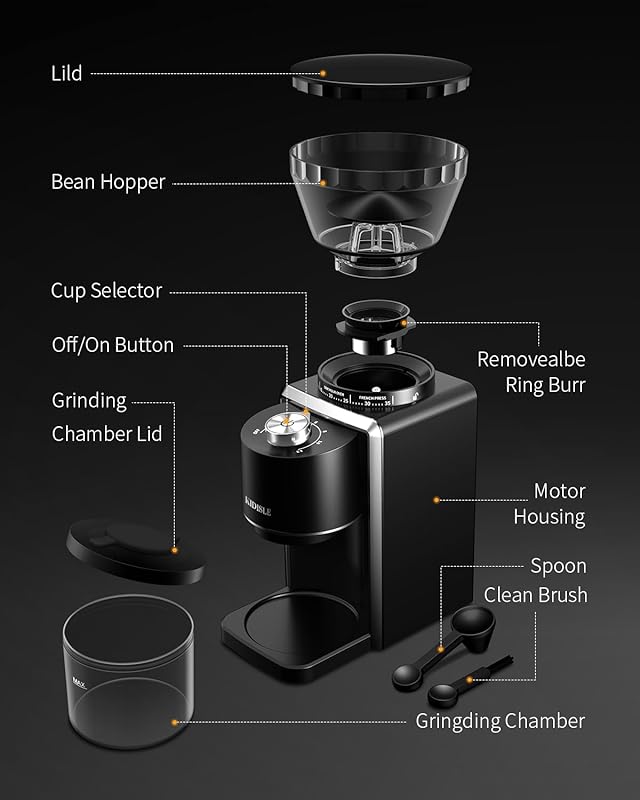
KIDISLE Conical Burr Coffee Grinder (35 Settings)
The KIDISLE is the easiest budget burr grinder to use for espresso beginners, with a simple dial system and transparent containers that let you see exactly what's happening.
Thirty-five grind settings provide decent fine-end resolution. The transparent bean hopper and ground container let you visually confirm your grind size and dosing, which is helpful when you're learning what good espresso grounds should look like. The 2-12 cup selector keeps dosing consistent.
At $59.99 with 176 reviews, the KIDISLE has more real-world feedback than most grinders at its price. Users report reliable daily performance for months. The premium burr mechanism delivers particles that work in pressurized baskets, and some users report success with unpressurized baskets after careful dialing.
Pros: - Transparent containers for visual monitoring - 35 settings with good fine range - Simple dial operation - 176 reviews validate reliability
Cons: - Static can be an issue at fine settings - No portafilter holder - Build quality is functional, not premium
Rounexes Burr Coffee Grinder (17 Settings)
The compact Rounexes at $59.99 brings flat burrs to the sub-$60 market, which is unusual and worth noting.
At just 5.5 inches wide and 8.2 inches tall, this grinder fits anywhere. The flat burrs with low grinding speed prevent heat transfer, preserving bean oils. Seventeen precision settings is fewer than the competition, but each step is meaningful. A single-button operation with smart timer and auto-shutoff simplifies the process.
The tool-free cleaning is a genuine positive. The grinding burr is accessible without tools, and the ground container and hopper lid are dishwasher-safe. At $59.99, the Rounexes offers flat burr grinding for the price of many conical options.
Seventeen settings is the main limitation. For espresso fine-tuning, each step between settings may be too large. This works best for people who find a setting that works for their beans and stick with it.
Pros: - Flat burrs at $59.99 - Ultra-compact footprint - Tool-free cleaning - Smart timer with auto-shutoff
Cons: - Only 17 settings limits fine-tuning - Steps between settings may be too large for espresso - 28 reviews is limited feedback
SHARDOR 64mm Premium Burr Coffee Grinder (100 Settings)
The premium SHARDOR at $249.99 is the ceiling of this roundup, and it's here because it brings commercial-grade features to the home counter.
The die-cast aluminum housing is a step above the standard SHARDOR model. The fully aluminum grinding chamber ensures minimal static and maximum stability during heavy use. The LED touchscreen interface with intuitive controls makes this feel like a professional appliance. SUS420 stainless steel flat burrs deliver the same uniform grind as the $170 model, but in a more premium package.
The 17.6oz hopper is the largest in this roundup, holding enough beans for multiple espresso sessions. One hundred programmable grind settings give you total control. The anti-static technology works exceptionally well on this model, keeping fine espresso grounds contained.
At $249.99, this is the grinder for someone who wants the best possible espresso grind without entering the $400+ tier. The build quality, grind performance, and user experience all justify the price jump from the standard SHARDOR.
Pros: - Die-cast aluminum construction - LED touchscreen interface - 64mm SUS420 flat burrs - 17.6oz hopper capacity
Cons: - $249.99 is significant spending - Only 10 reviews, very new - Die-cast housing adds weight
Buying Guide: Choosing an Affordable Espresso Grinder
Conical vs. Flat Burrs for Espresso Flat burrs produce more uniform particles with fewer fines, which creates cleaner espresso shots. Conical burrs work well enough for most home users, especially with pressurized baskets. If you're serious about espresso quality, flat burrs are worth the premium.
Minimum Settings for Espresso Twenty-five settings is the minimum. Thirty is better. Fifty or more gives you the micro-adjustment capability that espresso rewards. With fewer settings, each step in the fine range is too large, making it hard to dial in properly.
Portafilter Compatibility Grinders with portafilter holders save time and reduce mess. Check that the holder fits your specific portafilter size and style before buying. Some holders only work with specific dimensions.
Retention and Single-Dosing Lower retention means fresher doses. Traditional hopper grinders retain 1-3g. Single-dose designs with bellows retain under 0.1g. For espresso, where precise dosing matters, lower retention is better.
Frequently Asked Questions
What's the cheapest grinder that makes real espresso? The Aromaster at $69.99 is the cheapest I'd recommend specifically for espresso. Below that, you're using blade grinders or manual options that require significant effort and compromise.
Is a $170 grinder really that much better than a $70 one for espresso? Yes. The jump from a budget conical burr to a 64mm flat burr grinder produces noticeably cleaner, more balanced espresso shots. The difference is similar to upgrading from a decent espresso machine to a good one.
Can I use a blade grinder for espresso? Technically yes, practically no. The inconsistent particle sizes create channeling, uneven extraction, and weak crema. If you must use one, stick with pressurized portafilter baskets and accept the limitations.
How important is anti-static for espresso grinding? Very important. Fine espresso grinds generate more static than any other grind size. Without anti-static features, you'll lose grounds to clinging, create a mess, and potentially get inconsistent doses.
Should I buy a separate grinder or an espresso machine with built-in grinder? A separate grinder almost always outperforms a built-in grinder at the same total price point. Built-in grinders compromise on size, settings, and grind quality. If counter space allows, buy them separately.
How long does it take to dial in a new espresso grinder? Expect 4-8 shots to find your baseline setting with new beans. After that, minor adjustments of 1-2 settings as beans age over the week. More grind settings means faster and more precise dialing.
Conclusion
For the best affordable espresso grinder, the SHARDOR 64mm Flat Burr at $169.99 delivers commercial-grade uniformity that you'll taste in every shot. It's the performance sweet spot.
Under $100, the Aromaster 48-Setting at $79.98 offers the most espresso-relevant precision. The Aromaster 25-Setting at $69.99 is the cheapest option with a portafilter holder. And if you can stretch to $180, the Breville Smart Grinder Pro at $179.96 brings proven reliability with 6,820+ reviews backing its espresso performance.