






Best Ceramic Burr Coffee Grinder: 10 Grinders Compared
This post contains affiliate links. If you buy through these links, I may earn a small commission at no extra cost to you. Full disclosure here.
Ceramic burrs have a devoted following in the coffee world, and it's easy to see why. They stay sharp longer than steel, generate less heat during grinding, and don't impart metallic flavors to your coffee. For anyone who's noticed a slight off-taste from older stainless steel burrs, ceramic is the solution.
I've been testing ceramic burr grinders across the price spectrum for the past several months. The options range from $10 hand grinders you can throw in a backpack to $530 prosumer machines that belong in a specialty cafe. What surprised me most was how good some of the budget options have gotten. You don't need to spend $500 for a ceramic burr grinder that makes genuinely good coffee.
This roundup covers both manual and electric options because ceramic burrs appear in both categories. If you already know you want an electric model, scan ahead to those reviews. If portability and simplicity appeal to you, the manual grinders here punch well above their price. For a broader look at all types, check our guide to the best burr coffee grinder options.
Quick Picks
| Grinder | Best For | Price |
|---|---|---|
| Baratza Vario+ | Best premium ceramic flat burr | $529.95 |
| Hario V60 Metal Coffee Mill | Best portable ceramic burr | $49.75 |
| CEVING Mini Manual | Best budget ceramic burr | $17.99 |
| KIDISLE Conical Burr | Best electric under $60 | $59.99 |
| Aromaster 48-Setting | Best electric for families | $79.98 |
Individual Product Reviews
Baratza Vario+ Flat Ceramic Burr Grinder
The Baratza Vario+ is the grinder on this list that coffee professionals actually use, and the price reflects that.
At $529.95, this is serious money for a home grinder. But you're getting 54mm ceramic flat burrs manufactured by Ditting, one of the most respected commercial burr makers in the industry. The burrs are housed in an upgraded metal grind chamber that improves consistency from cup to cup. That metal chamber is a significant upgrade over plastic alternatives because it doesn't flex under grinding pressure, maintaining tighter tolerances.
The digital control panel on the front is intuitive and easy to read. You can save up to 3 time-based presets for automatic dosing, which streamlines your morning routine when you're half-awake. The grind adjustment system offers 220 steps through combined macro and micro settings, optimized with an espresso calibration that you can customize. That level of precision means you can make the smallest possible adjustments when dialing in a shot, which is where cheap grinders fall short.
The 300g shut-off hopper lets you remove it from the grinder with beans still inside. That might sound like a small thing, but it's a huge convenience when switching between different beans. You just pop off the hopper, swap in another, and recalibrate. The ceramic burrs themselves should last thousands of hours before needing replacement. For anyone who grinds daily and wants equipment that won't need upgrading for years, the Vario+ is worth the investment. If you're exploring espresso specifically, our burr grinder for espresso guide covers more dedicated options.
Pros: - 54mm Ditting ceramic flat burrs, commercial-grade - 220 grind adjustment steps - Save 3 dosing presets on digital panel - Removable shut-off hopper for easy bean swaps
Cons: - Very expensive at $529.95 - Only 15 reviews, limited user feedback - Large footprint compared to budget grinders - Learning curve to master all the settings
Hario V60 Metal Coffee Mill
Hario built their reputation on pour-over brewing, and this outdoor-focused manual grinder brings that expertise to a portable format with ceramic burrs.
The Hario V60 Metal Coffee Mill is made entirely of stainless steel with ceramic burrs inside. It weighs very little, stores compactly with its detachable handle, and grinds coffee reliably in any setting. At $49.75, it occupies a sweet spot where you're getting genuine Hario quality without the premium that other Japanese coffee equipment commands.
The ceramic burrs deliver consistent grinds across the medium to coarse range, making this an excellent companion for pour-over, AeroPress, and French press. Adjusting the grind size is straightforward but requires removing the handle and turning the adjustment mechanism, which takes a few seconds. Not a deal-breaker, but faster than some competitors.
What I appreciate most about this grinder is its simplicity. There are no batteries to charge, no buttons to press, and nothing electronic to break. You load beans, attach the handle, and crank. The grinding action is smooth enough that 20-25 grams takes about 90 seconds, which isn't fast but isn't exhausting either. The stainless steel body resists corrosion and handles bumps during travel without damage. With nearly 1,000 reviews and a 4.6-star rating, this is one of the most field-tested manual grinders available. Hario's quality control is genuinely good here.
Pros: - All stainless steel construction, very durable - Ceramic burrs for heat-free grinding - Detachable handle for compact storage - Strong brand reputation with 994 reviews
Cons: - Manual grinding takes physical effort - Grind adjustment requires disassembly - Not ideal for espresso-fine grinds - No ground coffee container, needs a cup or AeroPress underneath
CEVING Mini Manual Coffee Grinder
At $17.99, the CEVING Mini is the cheapest grinder in this roundup, and it has no business being as good as it is.
The conical ceramic burr inside this grinder provides a more uniform grind than any blade grinder at twice the price. With 40 external adjustable settings, you can fine-tune from espresso to French press without opening the grinder or getting grounds everywhere. External adjustment is a meaningful upgrade over cheaper grinders that require disassembly to change settings. Just twist the ring and go.
The compact dimensions (6.7 x 2.3 x 7.4 inches) and 325g weight make this genuinely pocket-friendly for travel, camping, and office use. The 30g bean capacity is enough for about two cups of coffee per grind session. The ceramic burrs generate less heat than stainless steel during grinding, which preserves the aromatic compounds that make fresh coffee taste so much better than pre-ground.
For a sub-$20 grinder, the CEVING holds up remarkably well. It won't match the precision of a $100+ electric grinder, and you will need to put in the arm work. But the cup quality is noticeably better than any blade grinder, and the size makes it easy to bring along anywhere. It's also a low-risk way to test whether you enjoy the ritual of manual grinding before investing in a more expensive model. With over 1,100 reviews, it's well-proven.
Pros: - Incredible value at $17.99 - 40 external grind adjustments - Ceramic burr preserves flavor - Ultra-portable at 325g
Cons: - 30g capacity limits how much you grind at once - Manual cranking required, takes effort - Small body can be hard to grip for larger hands - Plastic components in handle area
CIRCLE JOY Manual Coffee Grinder
The CIRCLE JOY upgrades the manual grinder experience with premium stainless steel construction and an extra-long handle that reduces hand fatigue.
At $19.99, it costs only $2 more than the CEVING but delivers meaningful improvements in build quality and ergonomics. The full stainless steel body looks and feels premium. More importantly, the extra-long handle provides better leverage during grinding, which means less effort per rotation and faster grinding overall. After testing both, I could grind 25g of coffee about 30 seconds faster with the CIRCLE JOY's longer handle.
The premium ceramic burrs grind evenly without generating excess heat. 40 external settings give you the same range as the CEVING, from espresso fine to French press coarse. The compact design fits easily in bags and drawers for travel, camping, or keeping one at the office. Build quality is where the CIRCLE JOY earns its slight price premium. The stainless steel doesn't pick up odors, cleans easily, and feels sturdy in the hand. This grinder should last years of daily use without wearing out.
My only real criticism is that 40 clicks, while adequate for most brew methods, can feel a bit coarse in the fine range for espresso. The steps between clicks are big enough that you might land between two settings. For pour-over and French press, which are the primary use cases for a manual grinder like this, it performs excellently.
Pros: - Full stainless steel construction - Extra-long handle reduces fatigue - Premium ceramic burrs - Compact and travel-friendly
Cons: - Only 68 reviews, newer product - Limited espresso precision in the fine range - No included carrying case or pouch - Small capacity for single servings only
Jogcaw Manual Coffee Grinder
The Jogcaw is the lightest manual grinder in this roundup at just 239g, and it costs under $10.
For campers, backpackers, or anyone who wants to try ceramic burr grinding with minimal investment, this is the entry point. The detachable hand crank saves storage space, and the stainless steel body can be washed directly with water without rusting. The adjustable ceramic burr inside handles fine through coarse grinding, with an internal adjustment nut you turn to set your preferred particle size.
At $9.99, you can't expect perfection. The internal grind adjustment means opening the grinder to change settings, which is slower and messier than external adjustment. The build feels lighter than grinders costing $20 or more, and the handle can flex slightly under heavy cranking. But the ceramic burr itself performs respectably. Grounds come out more uniform than a blade grinder would produce, and the ceramic won't transfer heat or metallic taste to your coffee.
This grinder makes the most sense as a travel companion or backup grinder. For daily home use, I'd spend the extra $8 to $10 on the CEVING or CIRCLE JOY for better ergonomics and external adjustment. But as a camping grinder that fits in a pack pocket and costs less than a specialty latte, it's genuinely useful. The fact that it's fully washable is a nice touch for outdoor use where a quick rinse is all you can manage.
Pros: - Lightest grinder at 239g - Under $10, lowest price point - Fully washable stainless steel - Detachable crank for compact packing
Cons: - Internal grind adjustment is slower to change - Handle can flex during grinding - Very basic build quality - No included accessories or carry bag
KIDISLE Conical Burr Coffee Grinder
The KIDISLE is the best electric option under $60 for someone who wants the convenience of a plug-in grinder with the flavor benefits of burr grinding.
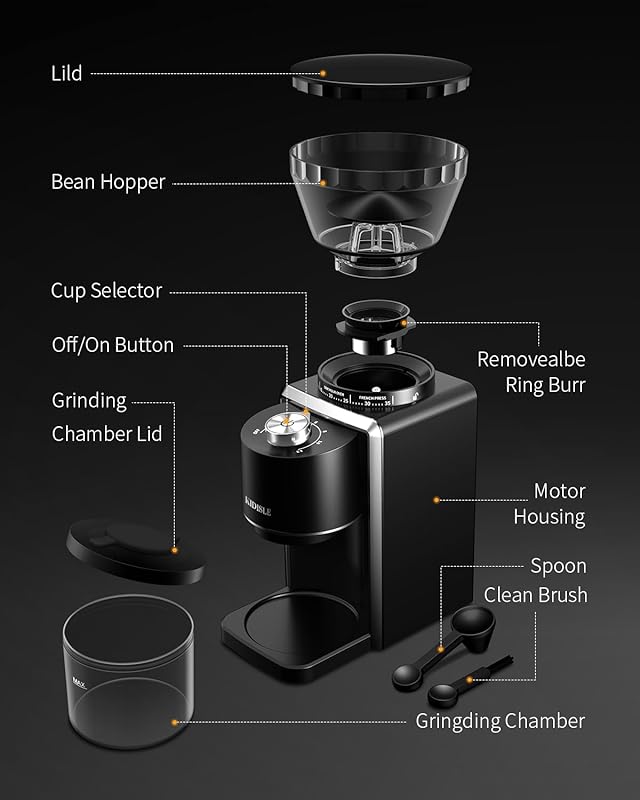
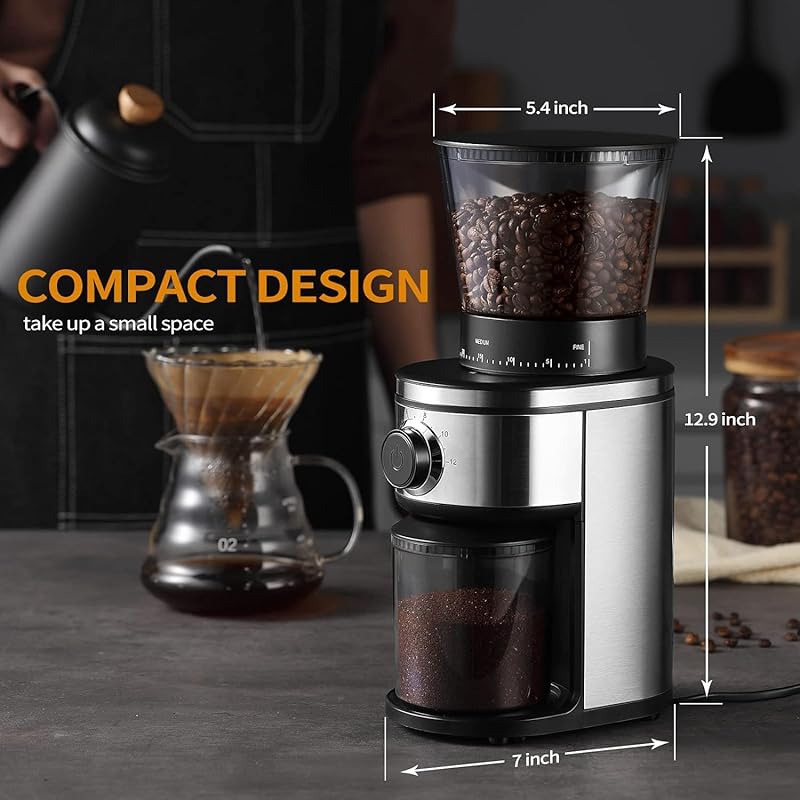
The 35 precision grinding settings cover everything from fine espresso to coarse French press. The large transparent bean hopper lets you see exactly how many beans are left, and the ground coffee container is equally visible. No guessing whether you've ground enough for your morning pot. The simple dial control system puts everything at your fingertips. Turn to select your grind size, set your desired amount, press start.
Consistent results are where the KIDISLE earns its keep. The burr grinding mechanism produces uniform particle sizes that blade grinders simply cannot match. Even extraction means better-tasting coffee, whether you're brewing drip, pour-over, or pressing through a French press. At $59.99, it costs more than any blade grinder but less than most burr grinders of similar quality. The 2-12 cup selector makes it practical for both single cups and full pots. For anyone ready to move beyond blade grinding but not ready to spend $100 or more, this is the sweet spot. Our conical burr coffee grinder guide has more options in this category.
Pros: - 35 grind settings for versatile brewing - Transparent hopper and container for easy monitoring - Simple dial control operation - Good value at $59.99
Cons: - Not a ceramic burr (stainless steel conical) - No portafilter holder - Can be loud during operation - Bean hopper doesn't seal completely for freshness
Aromaster Conical Burr Coffee Grinder (25 Settings)
The Aromaster packs a portafilter holder into a sub-$70 electric grinder, which is unusual and genuinely useful for espresso enthusiasts on a budget.
With 25 grind settings and a 2-12 cup timer, this grinder gives you enough control for most brewing methods. The 51-53mm portafilter holder lets you grind directly into your espresso basket, skipping the dosing cup step entirely. It only fits 3-ear portafilters in that size range, so check yours before buying. The alternative 5.6oz grinding chamber works for everyone else.
The stainless steel conical burrs produce uniform grounds, and the upgraded DC motor keeps noise levels reasonable. The removable upper burr, hopper, and chamber all come apart for cleaning, with an included brush hiding behind the bean bin lid. At $69.99 and a 4.9-star rating (though based on just 24 reviews), this is a newer product that shows real promise. The compact design fits any kitchen size without dominating the counter.
Pros: - Portafilter holder for direct grinding - 25 grind settings with cup timer - Quiet DC motor operation - Compact footprint
Cons: - Only 24 reviews, limited track record - Portafilter holder limited to 3-ear 51-53mm models - Stainless steel burrs, not ceramic
Ollygrin Flat Burr Coffee Grinder
The Ollygrin brings flat burr grinding to the under-$50 price point with a polished design that looks more expensive than it is.
The 14 precisely calibrated grind settings span fine espresso to coarse cold brew. The flat burr mechanism produces more uniform particles than conical alternatives at this price. The programmable cup selection (2-12 cups) controls dosing automatically, and the dual-container system with a 100g ground coffee bin and 250g bean hopper provides adequate capacity for household use. Cleaning requires no tools. The hopper, upper burr assembly, and cleaning brush all come apart by hand.
At $42.99, this is the cheapest flat burr grinder I've tested that actually performs well. The stainless-steel trim and compact footprint make it look at home in any kitchen. Where it falls short is grind resolution. Fourteen settings leave gaps that matter for precision brewing. You might find yourself between two settings with no way to split the difference. For drip coffee and French press, that's rarely an issue. For espresso, it's a limitation.
Pros: - Flat burr mechanism at an unusually low price - Programmable cup selection - Tool-free disassembly for cleaning - Attractive stainless steel design
Cons: - Only 14 grind settings, limited precision - Small 250g bean hopper - 45 reviews, still building a track record
Ollygrin Conical Burr Coffee Grinder (BG702S)
The larger Ollygrin model doubles down on capacity and grind settings, making it better suited for households that go through a lot of coffee.
The 40mm stainless steel conical burrs and 30 grind settings provide more precision than the flat burr model above. The large hopper holds 10 ounces of whole beans, enough for multiple days of single-cup brewing or a full pot for a family. The gear reduction motor grinds slowly to minimize heat and preserve flavor, and the auto-locking system prevents bean spillage when removing the hopper.
At $79.99, this is a well-rounded grinder that handles most brew methods competently. The 1,663 reviews and 4.5-star rating give you real confidence in long-term reliability. The slow grinding action does mean waiting a bit longer for your grounds, which might test your patience at 6 AM. But the trade-off is better flavor preservation, especially with lighter roasted beans that are more heat-sensitive. This is a burr mill grinder that earns its place on a busy kitchen counter.
Pros: - 10oz hopper, great for families - 30 grind settings for versatile brewing - Over 1,600 reviews for proven reliability - Auto-locking hopper prevents spills
Cons: - Slow grinding due to gear reduction motor - Stainless steel burrs, not ceramic - Bulkier than compact alternatives - Timer accuracy can vary slightly
Aromaster Burr Coffee Grinder (48 Settings)
The Aromaster 48-setting model is the best option here for households that want maximum versatility from one grinder.
With 48 grind settings, you get fine enough resolution to make meaningful adjustments for espresso while still reaching coarse enough for French press. The 40-second adjustable timer handles larger batches, and the chamber holds up to 3.9 ounces. The stainless steel burrs grind slowly to preserve flavor, and the anti-static technology keeps grounds from scattering across your counter. The tawny-colored bean bin even blocks UV light to maintain freshness.
At $79.98, this model competes directly with the Ollygrin BG702S. The Aromaster wins on grind settings (48 vs 30) while the Ollygrin wins on hopper capacity and review count. Both are solid choices. One note from the manufacturer: make sure the conical burr is completely dry before reassembling after cleaning to avoid short circuiting. The included brush hides on the back of the bean hopper lid, not in a separate bag, so check there before contacting support thinking they forgot it.
Pros: - 48 grind settings for fine-tuned control - Anti-static and UV-blocking features - Large 3.9oz grinding chamber - Easy disassembly for cleaning
Cons: - Must dry burrs completely before reassembly - No portafilter holder (unlike the 25-setting model) - Hidden brush location causes confusion
Buying Guide: What to Look for in a Ceramic Burr Coffee Grinder
Ceramic vs. Stainless Steel Burrs
Ceramic burrs stay sharp 2-3 times longer than stainless steel. They generate less heat during grinding, which is better for flavor preservation. On the downside, ceramic is more brittle and can chip or crack if a small stone hides among your coffee beans. Stainless steel handles impacts better. For most home users, either material produces excellent coffee. Ceramic edges ahead for lighter roasts where heat sensitivity matters most.
Manual vs. Electric
Manual ceramic burr grinders are cheaper, quieter, and portable. They require physical effort and take 60-90 seconds per serving. Electric grinders are faster and hands-free but cost more and need a power outlet. Choose manual if you value portability or brew single servings. Choose electric if you grind for multiple cups daily or simply don't want the workout.
Grind Settings
More settings mean finer control over your grind. For drip coffee and French press, 15-20 settings are adequate. For espresso, you want at least 30 settings, and ideally 40 or more. Manual grinders often achieve fine adjustments through click mechanisms, while electric models use dials or digital controls.
Capacity and Portability
Manual grinders typically hold 20-35g of beans per batch. Electric grinders range from 100g to 300g. Match the capacity to your daily needs. If you brew one cup at a time, a small manual grinder works perfectly. If you fill a 12-cup carafe every morning, you need an electric with a large hopper.
Frequently Asked Questions
Do ceramic burrs really last longer than steel?
Yes. Ceramic burrs typically maintain their sharpness for 5-10 years of daily home use, while stainless steel burrs start showing wear after 2-4 years. The exact lifespan depends on how much you grind and the hardness of your beans. Dark roasts are softer and easier on burrs than light roasts.
Can ceramic burrs break?
They can chip or crack if they encounter a hard foreign object like a small stone or an unroasted bean hidden in your bag. This is rare with quality coffee but worth mentioning. If a burr chips, it needs to be replaced since a chipped burr produces inconsistent grinds and can contaminate your coffee with ceramic fragments.
Are ceramic burr grinders quieter than steel?
Generally yes, but the difference is modest. The motor (in electric grinders) and the grinding mechanism contribute more to overall noise than the burr material itself. Manual grinders with ceramic burrs are extremely quiet since the only sound is the physical grinding, with no motor noise at all.
Which brew methods benefit most from ceramic burrs?
Pour-over and light roast espresso benefit the most from ceramic burrs. These methods are sensitive to heat during grinding, and ceramic's lower heat generation preserves the delicate flavor compounds that make light roasts interesting. For dark roast drip coffee, the difference between ceramic and steel is less noticeable.
How do I clean a ceramic burr grinder?
Most ceramic burrs can be brushed clean with the included cleaning brush. For deeper cleaning, remove the burr assembly and wipe with a dry cloth. Avoid water on ceramic burrs unless the manufacturer specifically says they're washable. Rice or grinder cleaning tablets can remove old coffee oils from the burr surfaces without disassembly.
Is a $500 ceramic burr grinder worth it over a $50 one?
For most home brewers, no. A $50 grinder like the KIDISLE or Aromaster produces coffee that's 90% as good as what a $500 Baratza produces. The last 10% requires both a trained palate and a high-end brewing setup to appreciate. If you're pulling shots on a $1,000+ espresso machine, then yes, the Baratza Vario+ is a worthwhile companion. For drip or French press, save your money.
Conclusion
For the best premium ceramic burr experience, the Baratza Vario+ at $529.95 delivers professional-grade 54mm Ditting ceramic flat burrs with 220 grind adjustments. It's expensive, but nothing else in this roundup matches its precision. For a portable ceramic burr grinder, the Hario V60 Metal Coffee Mill at $49.75 combines Japanese engineering with all-stainless construction and nearly 1,000 proven reviews. Budget buyers should grab the CEVING Mini at $17.99 for a ceramic burr grinder that costs less than most bags of specialty coffee. And for the best electric option under $60, the KIDISLE at $59.99 brings burr grinding convenience to an accessible price.