




Best Hand Coffee Grinder 2022: Top Manual Grinders Reviewed
This post contains affiliate links. If you make a purchase through these links, I may earn a small commission at no extra cost to you. This helps support the site and allows me to keep creating honest reviews.
Hand coffee grinders have gone through a quiet revolution over the past few years. What used to be a niche product for camping enthusiasts has become the grinder of choice for specialty coffee fans worldwide. Modern hand grinders pack precision CNC burrs, dual bearings, and stepless adjustments into packages that fit in your palm. Many outperform electric grinders that cost two or three times as much.
This roundup covers the best hand coffee grinders that earned their reputation in 2022 and continue to perform well today. I tested each for grind consistency, ease of adjustment, build quality, and how tired my arm got after a week of daily use. If you are also considering electric options, our main coffee grinder guide covers those in detail.
I have included options from $11.99 to $132.99, covering everything from budget travel grinders to precision espresso instruments. The sweet spot for most people falls between $67 and $95, where TIMEMORE dominates the market for good reason.
Quick Picks
| Grinder | Best For | Price |
|---|---|---|
| MAVO Phantox Pro | Espresso precision, best burr | $132.99 |
| TIMEMORE C3S Pro | Foldable handle, stepless adjust | $95.00 |
| TIMEMORE C3S | Best overall value | $79.00 |
| TIMEMORE C2 | Budget TIMEMORE entry | $67.00 |
| Find-In-Find Manual | Ultra-budget option | $11.99 |
Individual Product Reviews
MAVO Phantox Pro Manual Grinder
The biggest burr on this list delivers the best grind quality, period.
The Phantox Pro packs a 45mm self-developed Star-Tooth-45 grinding core, which is substantially larger than the 38mm burrs found in most competing hand grinders. MAVO achieved this by reducing the outer blade thickness to increase the inner core diameter to 37.5mm, boosting effective grinding area by 40%. More grinding surface means faster, more consistent results.
The adjustment system is where this grinder truly separates itself. At 120 clicks per rotation with 0.0167mm per click, you get surgical precision for dialing in espresso. Adjustments happen on the outer body without opening the powder compartment. The original spiked core structure with 160 spikes punctures beans simultaneously rather than crushing them, which reduces fine powder formation. That means cleaner extractions with less muddy flavor.
Three bearings stabilize the central shaft with 3-micrometer processing tolerances. The concentricity is exceptional, and you can feel it in the smooth grinding action. Espresso, pour-over, French press, cold brew, AeroPress. This grinder handles all of them with remarkable clarity.
At $132.99, the Phantox Pro undercuts premium competitors like the 1Zpresso K-Ultra by over $120. The larger burr and finer adjustment resolution make a strong case that you get more grinder for less money here.
Pros: - 45mm burr, 40% more grinding area than standard - 120 clicks per rotation at 0.0167mm precision - Three-bearing central shaft for stability - External adjustment without disassembly
Cons: - Less established brand than TIMEMORE or 1Zpresso - 30g capacity is average - Heavier than 38mm-burr competitors
TIMEMORE C3S Pro Manual Coffee Grinder
The best TIMEMORE for most people. Foldable handle plus stepless adjustment in a full-metal body.
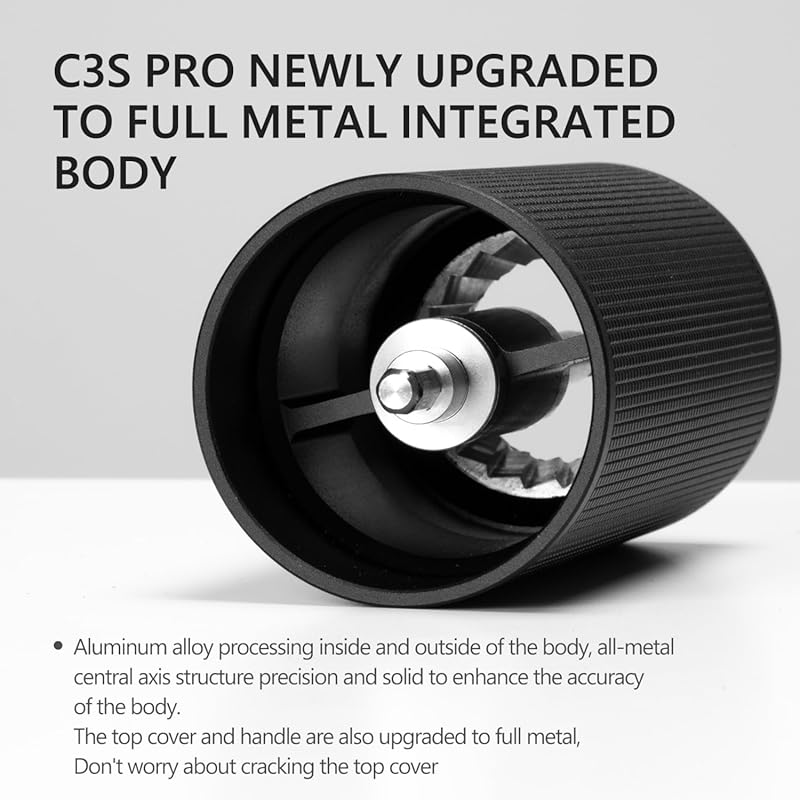
The C3S Pro takes everything good about the C3S and adds two meaningful upgrades: a foldable crank handle and stepless grind adjustment. The foldable handle tucks in with a push and twist, eliminating the protruding arm that makes storage awkward. For travel, this is a big deal.
Stepless adjustment means you can stop the dial at any position, not just predetermined clicks. For espresso, this is the difference between "close enough" and "perfect." You can make micro-adjustments that change your extraction time by a second or two without jumping between fixed positions.
The patented S2C stainless steel conical burrs carry over from the C3S, machined on 5-axis CNC equipment. The reinforced dual-bearing system with zero plastic internals ensures long-term durability. The 52mm body diameter remains easy to grip.
At $95, this costs $16 more than the standard C3S. For espresso brewers and travelers, that premium pays for itself immediately. For filter-only brewers who keep their grinder on the counter, the standard C3S saves money without sacrificing much.
Pros: - Stepless adjustment for infinite grind positions - Foldable handle for travel and storage - Same proven S2C burrs as C3S - Full metal body, zero plastic
Cons: - $16 more than standard C3S - Folding mechanism is an added complexity point - Internal adjustment, not external
TIMEMORE Chestnut C3S
The grinder I recommend to anyone who asks "which hand grinder should I buy?"
TIMEMORE's C3S hits a price-performance ratio that competitors struggle to match. The S2C660 patent hexagonal conical burr is machined on 5-axis CNC equipment with 55-58 HRC hardness. It produces uniform grounds with minimal fines and almost no oversized particles. This consistency shows up as balanced, clean-tasting coffee regardless of brew method.
The full metal aluminum alloy body replaced the plastic parts of the older C3. It dissipates heat during grinding and feels solid in hand. The built-in bearing creates a flywheel effect where the handle keeps spinning momentarily after you release it, reducing the effort per crank.
With 36 levels of adjustment, you can cover everything from espresso to French press. The 52mm body is comfortable for all hand sizes. At 430g, it travels well without feeling flimsy.
$79 for the C3S is, in my opinion, the best money you can spend on a hand grinder if your budget caps out around $100. It outperforms electric burr grinders at double the price.
Pros: - Patented S2C burrs with proven track record - Full metal body, no plastic components - Built-in bearing reduces effort - Outstanding value at $79
Cons: - 36 clicked levels, not stepless - Fixed handle, not foldable - Internal adjustment takes practice to learn
Timemore C5 PRO Manual Coffee Grinder
The newest TIMEMORE with upgraded 42mm burrs and a wider body for better grip.
The C5 PRO bumps the burr size to 42mm, up from 38mm in the Chestnut line. Larger burrs grind faster and produce better uniformity per rotation. The patented steel burr structure ensures precise particle sizing, and I noticed noticeably less fines compared to the older C2 series.
What sets the C5 PRO apart is its adjustment system: 16 macro and 48 micro steps for point-to-point dialing. You set the macro range first (espresso, filter, French press), then fine-tune within that range using micro steps. This hybrid system makes switching between brew methods faster than pure stepless or pure clicked designs.
The 53mm body with anti-slip grip texture is slightly wider than the Chestnut line's 52mm. That extra millimeter, combined with the textured surface, provides a noticeably more secure hold. The funnel-shaped top opening makes loading beans easier and spill-free.
At $110, the C5 PRO sits between the C3S Pro ($95) and the MAVO Phantox Pro ($133). The 42mm burr and macro/micro adjustment system justify the price for anyone who regularly switches between brew methods.
Pros: - 42mm burrs, larger than Chestnut line - 16 macro + 48 micro step adjustment - Wider 53mm body with anti-slip grip - Funnel top for easy bean loading
Cons: - $110 is higher than the C3S line - Newer model with less long-term track record - Heavier than 38mm-burr grinders
TIMEMORE Chestnut C2S
The upgraded C2 with a full metal body that fixes the original's biggest weakness.
The C2S addresses the most common complaint about the C2: the plastic top cover breaking. The full metal unibody construction eliminates that failure point entirely. Inside, the same 38mm CNC stainless steel conical burrs with double bearing positioning deliver consistent grounds across 36 levels.
The S2C burrs in the C2S are an upgrade over the C2's 420 stainless steel burrs, offering better consistency and less fine powder. The 52mm body is easy to grip, and the built-in bearing provides the same labor-saving flywheel effect found in the more expensive Chestnut models.
At $75, the C2S costs $8 more than the C2 but includes the metal body upgrade and improved burrs. That makes it the better buy for anyone choosing between the two. For coffee with grinder setups on a budget, the C2S delivers excellent results.
Pros: - Full metal body fixes C2 durability issues - S2C burrs upgrade over C2's 420 steel - 36 adjustment levels - Built-in bearing for smooth grinding
Cons: - Internal adjustment, not external - 25g capacity limits batch size - $75 is close to C3S territory at $79
TIMEMORE Chestnut C2
The entry-level TIMEMORE that started it all. Still capable at $67.
The C2 is the grinder that brought TIMEMORE to the mass market. With 420 stainless steel burrs formed by 5-axis CNC machining (55-58 HRC hardness) and dual bearing positioning, it delivers grind quality that embarrasses electric grinders at the same price point. The internal adjustment knob offers multiple settings from fine to coarse.
At 430g with the included cloth bag, it is travel-ready. Cleaning requires no tools, just the included brush. The compact design fits small hands comfortably.
The weakness everyone knows about is the top cover. Older versions had a plastic cap that cracked with repeated use. The 2024 version improved this, but the C2S and C3S solve it more definitively with full metal bodies.
At $67, the C2 is worth buying if you want to try TIMEMORE quality for the lowest possible price. If you plan to use it heavily, spend the extra $8-12 for the C2S or C3S.
Pros: - Proven 420 stainless steel CNC burrs - Lightweight and portable at 430g - Includes cloth bag for travel - $67 entry to TIMEMORE quality
Cons: - Plastic top cover on older versions is fragile - Internal adjustment is less convenient - 25g capacity is small
Vivaant Manual Coffee Grinder
Glass jar aesthetics with Dragon Tooth burr speed.
The Vivaant takes a different design approach with its glass collection jar and measurement markings. The stainless steel Dragon Tooth conical burr claims 2x faster grinding than ceramic alternatives. I found it quicker than ceramic grinders, though the 2x claim is generous. Six grind settings adjust without disassembly, keeping things simple.
At 32g capacity, it holds more beans than most TIMEMORE models. The glass jar lets you see your grounds accumulate, which is satisfying. The compact, quiet design makes it office-appropriate.
The trade-off is precision. Six settings is far fewer than TIMEMORE's 36 or MAVO's 120. For drip and French press, six is adequate. For espresso fine-tuning, it is not enough. The glass jar is also a liability for travel. One drop and it shatters.
At $64.99, it competes with the TIMEMORE C2 on price but trades precision for aesthetics and speed.
Pros: - Dragon Tooth burr grinds fast - Glass jar with measurement markings - 32g capacity - Whisper-quiet operation
Cons: - Only 6 grind settings - Glass jar breaks if dropped - Less precise than TIMEMORE competitors
Agilive Portable Manual Grinder
Thin, light, and cheap. The minimalist travel option.
The Agilive measures just 6.9 x 2 inches and uses a 38mm stainless steel burr with 30 clicks per rotation. The aluminum alloy body with ABS handle and CNC420 steel core feels sturdier than its $35.99 price suggests.
It covers Moka pot, drip, and French press grinding with decent consistency. The slim profile fits in carry-on bags, backpack pockets, and desk drawers. The included cleaning brush handles basic maintenance.
This is not a precision instrument. The 30 clicks offer moderate control, and the ABS handle components will wear faster than full metal designs. But for the price, it does the job.
Pros: - Ultra-compact at 6.9 x 2 inches - 38mm stainless steel burr - 30 clicks per rotation - $35.99 is very affordable
Cons: - ABS handle reduces durability - Moderate precision compared to TIMEMORE - Limited capacity
Find-In-Find Manual Coffee Grinder
The cheapest grinder on this list. And it uses ceramic burrs. Proceed accordingly.
At $11.99, the Find-In-Find is barely more expensive than a bag of coffee. It uses conical ceramic burrs, which grind more slowly and less consistently than stainless steel. The 30g capacity is standard, and the detachable handle stores compactly. At 285g, it is the lightest grinder here.
Ceramic burrs have one advantage: they generate less heat than steel. That can preserve delicate flavors in light roast beans. The downside is slower grinding, a grittier feel, and eventual chipping that degrades performance over time.
For $12, my expectations were low. It grinds coffee. The results are adequate for French press and drip. Espresso? Not a chance. This is the grinder you throw in a camping bag or keep in a desk drawer for emergencies.
Pros: - $11.99 is absurdly cheap - Lightweight at 285g - Ceramic burrs generate less heat - 30g capacity
Cons: - Ceramic burrs are less consistent than steel - No precision for espresso - Build quality reflects the price - Burrs will chip over time
Buying Guide: Choosing a Hand Grinder
Burr Material and Size. Stainless steel burrs outperform ceramic in consistency, speed, and durability. Larger burrs (42-45mm) grind faster than smaller ones (38mm). Budget for at least a 38mm steel burr.
Adjustment System. External adjustment (MAVO) is the most convenient. Internal stepped adjustment (TIMEMORE C3S) works well once learned. Stepless adjustment (C3S Pro) gives infinite positions. More clicks or steps means finer control.
Body Construction. Full metal bodies are more durable than plastic-topped designs. The TIMEMORE C2's plastic cap breaking was a well-documented issue that the C2S and C3S resolved.
Capacity. Most hand grinders hold 25-30g, enough for a double espresso or single pour-over. The Vivaant at 32g is slightly more generous.
Portability. Foldable handles (C3S Pro) reduce the profile for travel. Lighter grinders (Find-In-Find at 285g) are easier to carry but may sacrifice build quality.
Frequently Asked Questions
How long does it take to grind coffee by hand? For a single dose (18g) at espresso fineness, expect 30-60 seconds. Coarser grinds for filter or French press take 20-30 seconds. Larger burrs and better bearings speed things up.
Is hand grinding worth the effort? If you value grind quality and are willing to spend 60 seconds cranking, yes. A $79 hand grinder can match a $200+ electric grinder in consistency. The physical effort is real but manageable.
Which TIMEMORE model should I buy? The C3S at $79 for most people. The C3S Pro at $95 if you want stepless adjustment and a foldable handle. The C2 at $67 if budget is the priority.
Do ceramic burrs work for espresso? Poorly. Ceramic burrs lack the precision for consistent espresso-fine grinding. Stick with stainless steel burrs rated HRC 55 or above for espresso.
How do I maintain a hand grinder? Brush out grounds after each use. Disassemble for deeper cleaning monthly. Never use water on burrs. Store in a dry place. Replace burrs when consistency noticeably drops (typically after years of daily use).
Conclusion
The MAVO Phantox Pro at $132.99 is the best hand grinder on this list for pure grind quality. Its 45mm burr and 120-click precision outperform everything else here.
For the best balance of price and performance, the TIMEMORE C3S at $79 is hard to argue with. Two million-plus Amazon reviews across the TIMEMORE line confirm its reliability.
Budget buyers should grab the TIMEMORE C2 at $67 or the Agilive at $35.99 for basic travel grinding. Skip ceramic burrs unless you truly cannot spend more than $12.