




Best Hand Grinder: 8 Manual Coffee Grinders Worth the Effort
This post contains affiliate links. If you purchase through these links, we may earn a small commission at no extra cost to you. [Full disclosure here.]
There's something about grinding coffee by hand that electric grinders can't replicate. It's partly the ritual, partly the quiet, and partly the fact that a $75 hand grinder produces better grinds than most $200 electric models. That's not opinion. That's physics. Hand grinders use premium burrs in precision-machined housings because they don't need to allocate budget to motors, circuit boards, or noise dampening.
I've been using manual grinders daily for over a year. Some mornings I enjoy the process. Other mornings I curse it. But the coffee is always better than what I got from my old electric blade grinder, and the consistency matches my friend's $300 Baratza. The grinders on this list represent the best hand coffee grinders available on Amazon right now, spanning from budget-friendly to premium.
If you're considering a hand grinder for the first time, this guide will help you pick the right one. I tested each model for grind consistency, ease of turning, adjustment precision, build quality, and portability. Here's what I found.
Quick Picks
| Grinder | Best For | Price |
|---|---|---|
| TIMEMORE C3S Pro | Best overall hand grinder | $95.00 |
| TIMEMORE C3S | Best value under $80 | $79.00 |
| KINGrinder P0 | Best budget option | $22.00 |
| KINGrinder K2 | Best mid-range | $77.00 |
| TIMEMORE C2 | Best for beginners | $67.00 |
Individual Product Reviews
TIMEMORE Chestnut C3S Pro
The best hand grinder you can buy under $100, period.
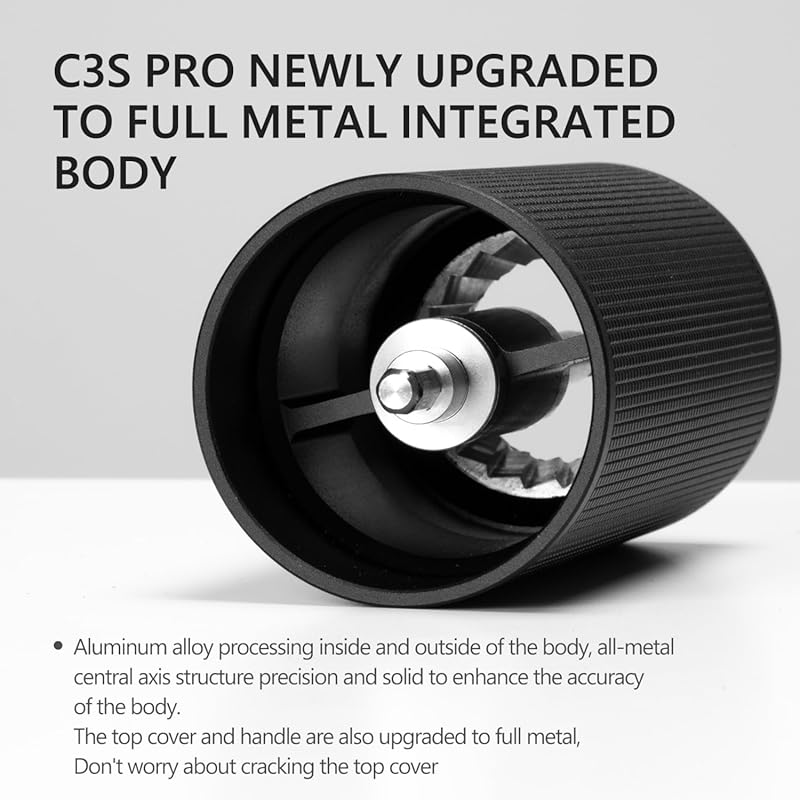
The C3S Pro is TIMEMORE's most refined mid-range model. The full metal aluminum body is built to survive daily use and the occasional drop. The patented S2C660 stainless steel conical burrs are CNC-machined to 55-58 HRC hardness, which produces uniform particles with minimal fine powder. The foldable crank handle is the upgrade that separates it from the standard C3S, saving storage space and preventing the grinder from tipping over.
Grinding feel is smooth thanks to the built-in bearing that keeps the handle spinning even after you release your grip. The 52mm body diameter fits comfortably in smaller hands. At just over a pound, it's light enough for travel but heavy enough to feel substantial. The all-metal internals mean zero plastic parts that could wear out.
At $95.00, the C3S Pro costs $16 more than the standard C3S. The foldable handle is the primary difference. If you travel with your grinder or have limited storage, the extra cost is worth it. If it stays on your kitchen counter, save the money and grab the standard version.
Pros: - Foldable handle for storage and travel - S2C660 patent burrs with 55-58 HRC hardness - Full metal aluminum body, no plastic - Smooth grinding with built-in bearing
Cons: - $95 is at the top of the budget range - 25g capacity limits batch sizes - Handle folding mechanism adds a slight rattle
TIMEMORE Chestnut C3S
The same premium burrs as the Pro version, minus the foldable handle.
The C3S shares the S2C660 burrs and all-metal body with the C3S Pro. The difference is the fixed handle instead of foldable. Everything else is identical: 36-level adjustable coarseness, double bearing central axis, 52mm body, and approximately 530g weight. For home use where portability isn't a priority, the C3S gives you the same grind quality for $16 less.
The S2C burr system is what makes TIMEMORE grinders popular in specialty coffee circles. The hexagonal cutting design reduces excessively coarse particles while minimizing fine powder. The result is a cleaner cup with more defined flavor notes. Whether you're making pour over, French press, or espresso, these burrs handle the full range.
At $79.00, the C3S sits at the sweet spot of price and performance. It outgrinds most electric grinders under $200 and will last longer too, since there's no motor to burn out. If the Timemore hand grinder line appeals to you, this is the model I'd recommend for most people.
Pros: - S2C660 patent burrs, same as Pro - All-metal aluminum body - 36 adjustable coarseness levels - $16 cheaper than C3S Pro
Cons: - Fixed handle doesn't fold for storage - 25g capacity - Premium price for a "standard" model
KINGrinder P0 Lightweight Manual Grinder
The best hand grinder under $25 for pour over and French press.
At $22.00, the KINGrinder P0 is proof that good coffee doesn't require a big investment. The ABS body keeps weight down to just 330g, making it the lightest grinder on this list. The stainless steel SUS420 conical burr produces consistent grinds recommended for drip coffee and moka pot. Capacity is 20g per batch.
The 30 clicks per rotation allow fine adjustment at 0.0333mm per click. That's precise enough for drip and French press, though espresso fans will want something with more adjustment range. Disassembly requires no tools, and a cleaning brush is included. The straightforward design means there's almost nothing that can break.
For anyone dipping their toes into manual grinding, the P0 is the lowest-risk starting point. You'll outgrow it if you get serious about espresso, but for everyday drip or pour over coffee, it does the job well for the price of a few coffee drinks at your local shop.
Pros: - Just $22.00 - Lightest option at 330g - 30 clicks per rotation for fine adjustment - Tool-free disassembly
Cons: - ABS plastic body, not metal - 20g capacity is small - Not designed for espresso-fine grinding
KINGrinder K2 Manual Hand Grinder
A full-metal upgrade from the P0 with dual bearings and finer adjustment.
The K2 jumps to 18 microns per click and 40 clicks per rotation, giving you tighter control than the P0. The full metal aluminum body is more durable and feels better in the hand. The stainless steel burr set with dual bearing design ensures consistent grinding over time, since the bearings keep the burrs aligned as they wear.
Capacity is 20-25g, enough for a double espresso or a single pour over. The interior adjustment lets you set the grind from fine to coarse, and the grinder handles multiple brew methods. The aluminum body is more durable than the P0's ABS plastic. Disassembly is tool-free for cleaning, and the compact size makes it a solid travel companion.
At $77.00, the K2 sits between the budget P0 and premium TIMEMORE models. It's a great middle ground for someone who wants metal build quality and finer adjustment without spending $95-100. The K2 has earned a YouTube recommendation from a 2-million subscriber channel, which speaks to its grind quality.
Pros: - 18 micron clicks for precise adjustment - Full metal aluminum body with dual bearings - Tool-free disassembly - YouTube-endorsed by major reviewers
Cons: - Interior adjustment requires opening the grinder - 20-25g capacity limits batch size - $77 is mid-range territory
Agilive Manual Coffee Grinder
A budget all-metal grinder with 30 clicks per rotation and espresso capability.
The Agilive offers a 38mm stainless steel burr in an aluminum alloy body for $35.99. That's less than half the price of the TIMEMORE C3S while delivering a full metal build. The 30 clicks per rotation cover moka pot, drip, French press, and basic espresso. The ultra-thin profile at 6.9 x 2 inches makes it one of the most portable options here.
Build quality is solid with an ABS handle and CNC420 steel core. The included cleaning brush makes maintenance easy, and disassembly requires no tools. The grinder handles daily use without showing wear.
The trade-off compared to TIMEMORE and KINGrinder is burr precision. The Agilive's burrs aren't CNC-machined to the same tolerance, which means slightly wider particle distribution. For drip and French press, this doesn't matter much. For espresso, you'll notice the difference. At $35.99, it's a strong value for someone who mainly brews filter coffee.
Pros: - Full metal body at $35.99 - 38mm stainless steel burr - Ultra-slim 6.9 x 2 inch profile - Tool-free disassembly with brush included
Cons: - Burr precision lags behind TIMEMORE/KINGrinder - ABS handle instead of full metal - Less consistent at espresso-fine settings
TIMEMORE Chestnut C2
The original TIMEMORE that launched a hand grinder revolution, now at $67.
The C2 is where TIMEMORE's reputation started. The 420 stainless steel burrs are formed by five-axis CNC cutting to 55-58 HRC hardness. The dual bearing center axis keeps particles uniform. The grinding degree adjustment knob lets you dial in fine to coarse with a simple turn. The cloth bag, brush, and manual come included.
At 430g, the C2 balances lightweight portability with enough heft to feel solid. The compact design fits smaller hands. The built-in bearing creates a flywheel effect where the handle keeps spinning after you release, reducing the effort per turn.
This is the original model, and it has a known weakness: the top cover can crack with heavy use. The C2S (upgraded version) solves this with a full metal unibody. At $67, the C2 is still a good grinder, but the $8 upgrade to the C2S at $75 is worth it for the improved durability. I'd recommend the C2 only if you're strictly budget-limited.
Pros: - Five-axis CNC-machined 420 steel burrs - Dual bearing for alignment - Lightest TIMEMORE at 430g - Includes cloth bag for travel
Cons: - Plastic top cover prone to cracking - C2S is a better value for $8 more - 25g capacity
TIMEMORE Chestnut C2S
The C2 fixed. Full metal body, same great burrs, no more cracking.
The C2S is the upgrade the C2 needed. The full metal unibody eliminates the plastic top cover that broke on the original. The S2C conical burrs (38mm) are CNC-machined, an upgrade from the C2's 420 steel. Double bearing central axis positioning keeps grinding particles even. The 36-level adjustable coarseness covers everything from espresso to cold brew.
The 52mm body is easy to grip, and the bearing-assisted movement makes grinding feel lighter than you'd expect. Weight is around 530g, heavier than the C2 but justified by the all-metal construction. This is the hand coffee grinder I'd buy as a gift for someone getting into specialty coffee.
At $75.00, it's $8 more than the C2 and $4 less than the C3S. The C3S has the same burrs and build. The main difference is that the C3S is a slightly newer design. For most people, the C2S at $75 is the sweet spot in the TIMEMORE lineup.
Pros: - Full metal unibody fixes C2's cracking issue - Upgraded S2C conical burrs - 36-level adjustable coarseness - Double bearing for long-term consistency
Cons: - Heavier than C2 at 530g - No foldable handle - Internal adjustment is less convenient than external
Buying Guide: What to Look for in a Hand Coffee Grinder
Burr Material and Quality
Stainless steel burrs last longer and stay sharper than ceramic. CNC-machined burrs (like TIMEMORE's S2C) produce the most uniform particles. Look for HRC hardness ratings of 55+ for long-lasting performance. Cheaper burrs wear down faster and produce more fine powder over time.
Adjustment Type: Internal vs. External
Internal adjustment means you turn a nut underneath the burr to change grind size. External adjustment uses a dial on the outside of the grinder. External is faster and more convenient, especially if you switch between brew methods. Internal is fine if you grind at the same setting every day.
Body Material
Aluminum alloy bodies are durable and lightweight. ABS plastic bodies are cheaper but can crack with impact. Full metal construction (no plastic parts) is ideal for longevity. The weight difference between plastic and metal bodies is about 100-200g, which matters for travel.
Capacity
Most hand grinders hold 20-35g per batch. That's 1-2 servings. If you need to grind for multiple people, you'll be doing several batches. For solo brewing, 20-25g is adequate. For couples or small groups, look for 30g+ capacity.
Bearing System
Single bearing grinders wobble more during use, which creates uneven particle sizes. Dual bearing systems (like TIMEMORE and KINGrinder models) keep the burrs aligned and produce more consistent results. The bearing also creates a flywheel effect that makes grinding feel easier.
FAQ
How long does it take to grind coffee by hand?
For medium grind (drip/pour over): 30-45 seconds per 20g dose. For fine grind (espresso): 45-90 seconds per 18g dose. For coarse grind (French press): 20-30 seconds per 25g dose. Premium grinders with sharp burrs and bearings grind faster than budget models.
Is a hand grinder better than an electric grinder?
For grind quality per dollar, yes. A $75 hand grinder matches or beats $200+ electric grinders in particle consistency. The trade-off is physical effort and time. If you grind more than 40g at a time regularly, electric is more practical.
Can I use a hand grinder for espresso?
Yes, if it has enough adjustment precision. Grinders with 8-20 micron clicks per adjustment step (like 1Zpresso and TIMEMORE ESP models) produce excellent espresso grinds. Budget models with 30+ micron steps can grind fine enough but lack the precision for exact dialing. Check our Hario hand grinder guide for more options.
How do I clean a hand grinder?
Brush out retained grounds after each use. Deep clean by disassembling the burr assembly (tool-free on most models) and brushing all surfaces every 2-4 weeks. Never use water on the burrs unless specified as safe. Moisture causes rust and damages the cutting edges.
Which TIMEMORE model should I buy?
For most people: C2S at $75. It fixes the C2's durability issues with a full metal body while keeping the price reasonable. The C3S at $79 is slightly newer but functionally similar. The C3S Pro at $95 adds a foldable handle for travel. Skip the original C2 unless budget is extremely tight.
Do hand grinders wear out?
The burrs will eventually dull after years of daily use. Stainless steel burrs last longer than ceramic. Most premium hand grinders last 5-10 years before needing burr replacement. The body and bearings should outlast the burrs easily with proper care.
Conclusion
The TIMEMORE Chestnut C3S Pro at $95 is my top pick for anyone willing to invest in a hand grinder that'll last for years. The foldable handle, S2C burrs, and all-metal construction make it the most refined option under $100.
For the best value, the TIMEMORE C2S at $75 delivers 90% of the C3S Pro's performance for $20 less. It's the model I recommend most often to people entering the hand grinder world.
Budget shoppers should start with the KINGrinder P0 at $22. It's the cheapest way to experience real burr grinding and decide if the manual process works for your morning routine. If it does, upgrade to a TIMEMORE or KINGrinder K2 later.