




Best Hand Grinder for Espresso: 9 Manual Grinders Tested
This post contains affiliate links. If you make a purchase through these links, I may earn a small commission at no extra cost to you. This helps support the site and allows me to keep creating helpful content.
Espresso demands precision. The grind needs to be fine, consistent, and uniform. A single coarse particle can create a channel in the puck and ruin your shot. That's why most people assume you need an expensive electric grinder to make decent espresso at home. They're wrong.
A good hand grinder can produce espresso-quality grounds that rival electric grinders costing three to four times as much. The key is the burr set. Modern manual grinders use CNC-machined stainless steel conical burrs that achieve remarkable consistency. You trade speed for quality and savings. Grinding 18 grams of beans takes about 30 to 45 seconds of cranking, but the results in the cup speak for themselves.
I've tested these grinders specifically for espresso performance. That means I focused on fine grind consistency, step resolution (how small the adjustments are between settings), grind speed, and retention. If you're looking for a broader overview of espresso grinder options including electric models, I have a separate guide. For hand grinders paired with an espresso machine with grinder setup, the models below represent the best standalone manual options available right now.
Quick Picks
| Product | Price | Best For |
|---|---|---|
| TIMEMORE C3S Pro | $95.00 | Best overall for espresso |
| KINGrinder K2 | $77.00 | Best precision adjustment |
| Turin H40 V2 | $65.00 | Best value with premium features |
| Hxswkk F18SW1 | $49.99 | Best ergonomic design |
| TIMEMORE C2S | $75.00 | Best all-rounder |
Individual Product Reviews
TIMEMORE Chestnut C3S Pro
The upgraded TIMEMORE that serious espresso lovers should consider first.
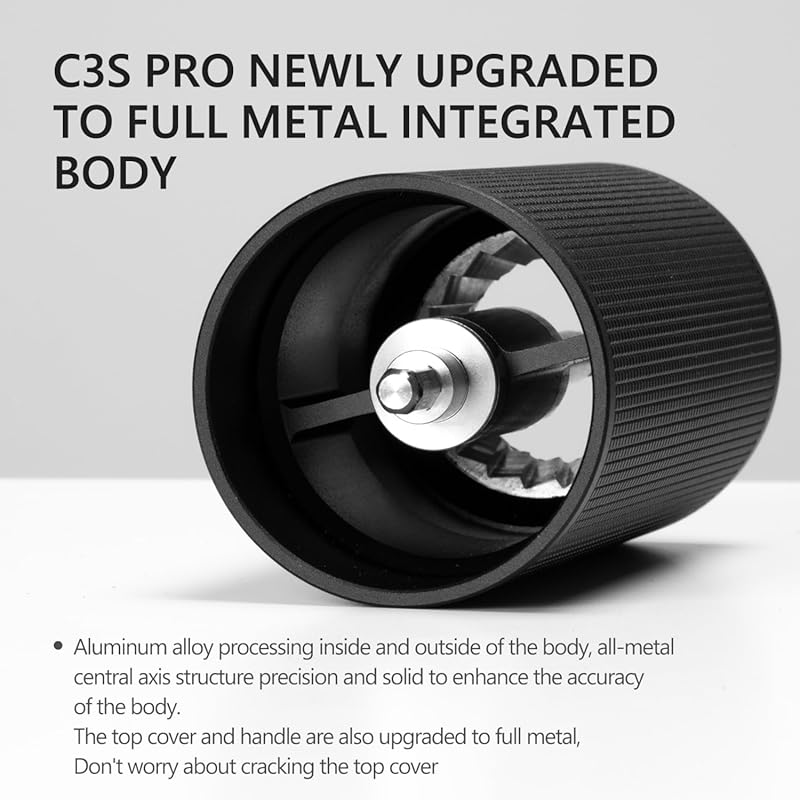
TIMEMORE has built a strong reputation in the hand grinder world, and the C3S Pro represents their best mid-range offering. The S2C660 patent hexagonal conical burr is machined on 5-axis CNC equipment with 55-58 HRC hardness. What does that mean in practical terms? Extremely uniform grinding with almost no oversized coarse particles and minimal fine powder. Both of those problems ruin espresso extraction.
The full metal aluminum alloy body replaced the older C3 Pro's plastic components, solving durability complaints from earlier models. The foldable crank handle makes it genuinely portable for travel, and the built-in bearing creates a momentum effect that makes grinding feel lighter. With 2,103 reviews at 4.8 stars, the community has validated this grinder thoroughly. My one criticism is the internal adjustment system. It works fine once you learn it, but external adjustments (like on the Turin H40) are faster to dial in for espresso.
Pros: - S2C660 patent burr for exceptional consistency - Full metal body with improved durability - Foldable handle for portability - Built-in bearing reduces grinding effort
Cons: - Internal grind adjustment is slower to change - $95 price point may stretch some budgets - 52mm body can be tight for larger hands
KINGrinder K2 (Iron Gray)
Precision at 18 microns per click, purpose-built for espresso adjustment.
The KINGrinder K2 stands out with its 18-micron per click adjustment. That's incredibly fine resolution. With 40 clicks per full rotation, you get exceptional control over grind size in the espresso range. This matters because espresso is unforgiving. A tiny change in grind size can mean the difference between a 25-second pull and a 35-second bitter mess.
The full metal aluminum body and stainless steel burr set feel premium in hand. The dual bearing design improves stability during grinding, which translates to more consistent particle sizes. The 20-25g hopper capacity is enough for a single or double shot. Tool-free disassembly makes cleaning simple, and the straight handle design feels natural during grinding. At $77, it sits competitively between budget manual grinders and the $150+ premium tier. For espresso-focused grinding, the precision adjustment alone justifies the price. The interior adjustment takes a moment to access, but the payoff in grind control is worth it.
Pros: - 18-micron click resolution for espresso precision - Full metal construction with dual bearings - 40 clicks per rotation for fine control - Tool-free disassembly for easy cleaning
Cons: - Interior adjustment design (not external) - 20-25g capacity limits batch grinding - Straight handle may not suit everyone's grip
Turin H40 V2 Manual Coffee Grinder
Premium features at a mid-range price, with a magnetic dosing cup that espresso lovers will appreciate.
The Turin H40 V2 packs several features that feel like they belong on a $100+ grinder. The 40mm stainless steel 7-core burrs grind consistently across the full range. External grind size adjustment is the highlight here. You turn a knob on the outside of the grinder to change settings, no disassembly needed. When you're dialing in espresso and making small adjustments between shots, this saves real time.
The 58mm magnetic dosing cup is designed to fit directly onto most espresso machine portafilters, and the included blind shaker plunger helps with WDT-style distribution. The aluminum body with walnut handle looks and feels premium. At $65 with 11 reviews at 5 stars, it's newer to market but the early feedback is strong. The 30g capacity handles double shots with room to spare. If you value quick adjustment changes and a streamlined workflow from grinder to portafilter, the Turin H40 V2 punches well above its price.
Pros: - External grind adjustment for quick changes - 58mm magnetic dosing cup fits portafilters - Walnut handle with premium build quality - Competitive price at $65
Cons: - Only 11 reviews so far (limited track record) - 40mm burrs are smaller than some competitors - New brand without established service reputation
Hxswkk Hand Coffee Grinder (F18SW1)
Ergonomic "small waist" design that's genuinely comfortable during extended grinding.
Most hand grinders are cylindrical tubes. The Hxswkk breaks that mold with a tapered "small waist" body that provides a more natural grip. When you're grinding fine for espresso (which takes more effort than coarser settings), comfort matters. The aviation-grade aluminum alloy body keeps it lightweight but durable, and the vintage walnut wood handle adds tactile warmth.
The CNC420 stainless steel hexagram conical burr delivers uniform cutting with 28 external precision steps. External adjustment is a big plus for espresso workflows. The extended stainless steel crank arm reduces the force needed per revolution, and the 30g hopper handles standard espresso doses. At $49.99, it's the most affordable grinder on this list that I'd genuinely recommend for espresso. The 3 reviews and 5-star rating are too early to draw conclusions from, but the feature set and build materials suggest solid performance. Quiet operation is another benefit if you grind early in the morning.
Pros: - Ergonomic tapered body for comfortable grip - External 28-step precision adjustment - Extended crank arm reduces grinding effort - Quiet manual operation
Cons: - Very few reviews (only 3 so far) - 28 steps may be limiting for espresso fine-tuning - New brand with unproven long-term durability
TIERRA TRAZZA Manual Coffee Grinder
A well-built all-purpose grinder with a velvet travel pouch included.
The TIERRA TRAZZA grinder focuses on the tactile experience. The diamond-pattern grip makes the body easy to hold, and the precision-machined stainless steel burrs produce a consistent grind. The aluminum-alloy body with real walnut accents feels substantial without being heavy. A velvet pouch comes in the box for travel protection.
At $49.99 with 37 reviews at 4.9 stars, it's building a loyal following. For espresso, the stainless steel burrs grind fine enough to pull decent shots. The compact design slips into bags easily for travel, which is great if you bring your espresso coffee grinder to the office or on trips. My concern for espresso specifically is the lack of published click count or step resolution data. Without knowing the microns per click, it's harder to gauge how precisely you can dial in compared to the KINGrinder K2 or TIMEMORE models. For pour over and French press, it's excellent. For serious espresso, I'd want more granularity information.
Pros: - Diamond-pattern grip for secure holding - Real walnut accents with premium feel - Includes velvet travel pouch - Strong early review scores (4.9 stars)
Cons: - No published step resolution for espresso precision - Limited review count (37 reviews) - No foldable handle for storage
KINGrinder P0
The entry-level KINGrinder that's better suited to drip and French press.
At $22, the P0 is KINGrinder's most affordable option. It weighs just 330g (constructed from ABS plastic) and grinds up to 20g at a time. The SUS420 stainless steel conical burr provides 30 clicks per rotation with 0.0333mm per click adjustment. Tool-free disassembly makes cleaning straightforward.
I want to be honest here. The P0 is recommended by KINGrinder themselves for drip coffee, not espresso. The 33-micron step size is too large for precise espresso dialing. You can get into the fine range, but making the small adjustments between "close" and "perfect" espresso grind is difficult. For Moka pot, pour over, and French press, it performs well above its price point. If espresso is your goal and budget is tight, save up for the K2 at $77 instead. The P0 works as a good espresso grinder starter but has real limitations.
Pros: - Incredibly affordable at $22 - Lightweight at 330g - Tool-free cleaning - 30 clicks per rotation for basic adjustability
Cons: - Not designed for espresso-fine grinding - ABS plastic body (less durable than metal) - 20g capacity is tight for double shots - 33-micron steps too coarse for espresso precision
Agilive Manual Coffee Grinder (White)
A slim, attractive grinder with solid burr specs at a reasonable price.
The Agilive stands out visually with its white color option and ultra-thin profile (6.9 x 2 inches). The 38mm stainless steel burr with CNC420 steel core delivers precision grinding, and 30 clicks per rotation allow adjustments for Moka pot, drip, and French press.
At $35.88, the build quality impresses. The aluminum alloy body and ABS handle keep weight down while maintaining durability. The included cleaning brush simplifies maintenance. For espresso, the 30 clicks per rotation provide reasonable adjustability, though dedicated espresso grinders like the KINGrinder K2 offer finer resolution. The white aesthetic is a nice change from the sea of black and gray grinders on the market. With 66 reviews at 4.8 stars, early adopters seem satisfied. If you want a travel-friendly grinder that handles espresso adequately and looks good on your desk, the Agilive fits the bill.
Pros: - Slim, attractive white design - 38mm stainless steel CNC420 burr - Lightweight and highly portable - Reasonable price at $35.88
Cons: - 30 clicks per rotation may limit espresso precision - ABS handle less durable than full metal - Smaller 38mm burr grinds slightly slower
TIMEMORE Chestnut C2S (B0DXF7DXBK)
The full metal upgrade to TIMEMORE's legendary C2 line.
The original TIMEMORE C2 had one well-known flaw: the plastic top cover cracked easily. The C2S fixes this with a full metal unibody construction. The 38mm CNC-machined stainless steel conical burr with 55-58 HRC hardness delivers the same excellent grind quality the C2 was known for. Double bearing central axis positioning ensures uniform grinding with minimal wobble.
At $75 with 2,649 reviews and a 4.7-star rating, this is one of the most battle-tested manual grinders you can buy. The internal adjustment knob gives you precise control from Turkish fine through French press coarse. Weighing 700g, it has a substantial feel without being heavy. For espresso, the 38mm burr handles fine grinding competently, and the dual bearings reduce the effort needed. If you want a proven grinder from an established brand and you're willing to work with internal adjustments, the C2S is hard to beat. Pair it with an espresso machine and grinder setup for a reliable daily workflow.
Pros: - Full metal body fixes C2 durability issues - 38mm CNC burr with 55-58 HRC hardness - Double bearing for stability - Massive review count confirms reliability
Cons: - Internal grind adjustment (not external) - 700g heavier than some travel options - 25g capacity may be tight for larger doses
TIMEMORE Chestnut C2S (B0CGTYT12R)
The S2C burr version of the C2S with 36-level grind adjustment.
This variant of the C2S features the S2C conical burr and offers approximately 36 levels of grind adjustment. The full metal unibody construction is identical to the other C2S model, addressing the same durability concerns of the original C2. The 52mm body is easy to grasp even for smaller hands, and the built-in bearing creates momentum that makes grinding feel lighter.
At $75 with 2,394 reviews at 4.7 stars, it has nearly the same community validation as its sibling. The main difference is the S2C burr geometry, which some users prefer for its slightly different flavor profile. The labor-saving bearing is a real benefit during espresso grinding, where fine settings require more force. Clockwise rotation gives finer powder, counterclockwise goes coarser. It's intuitive once you learn it. Choosing between this and the other C2S comes down to burr preference. Both are excellent for espresso.
Pros: - S2C conical burr for consistent grinding - Approximately 36 adjustment levels - Labor-saving bearing design - Proven reliability with 2,394 reviews
Cons: - Internal adjustment only - 25g capacity - Difficult to tell apart from other C2S model
Buying Guide: What to Look for in a Hand Grinder for Espresso
Step Resolution (Microns Per Click)
This is the most important spec for espresso. The KINGrinder K2 at 18 microns per click lets you make tiny adjustments. The P0 at 33 microns is too coarse for fine-tuning. Look for grinders with 25 microns or less per click for serious espresso work.
Burr Material and Size
Stainless steel burrs with high HRC hardness (55+) cut cleaner than softer metals. Larger burrs (40mm+) grind faster and often more uniformly. The TIMEMORE S2C660 and KINGrinder conical burrs are among the best in the manual grinder category.
External vs. Internal Adjustment
External adjustment (Turin H40, Hxswkk) lets you change grind size without disassembly. Internal adjustment (TIMEMORE, KINGrinder) requires removing parts to access the dial. For espresso, where you adjust frequently between beans and shots, external adjustment saves meaningful time.
Build Quality and Materials
Full metal bodies (aluminum alloy) outlast ABS plastic shells. Walnut handles provide warmth and grip. Double bearings reduce wobble and improve consistency. Avoid grinders with plastic top caps, as they tend to crack with repeated use.
Capacity
Espresso doses range from 14g to 20g typically. A 25-30g capacity grinder handles double shots comfortably. Grinders under 20g may require two fill-and-grind cycles for larger doses.
Frequently Asked Questions
Can a hand grinder really produce espresso-quality grounds?
Yes. Modern hand grinders with CNC-machined steel burrs produce grounds that are comparable to electric grinders in the $200-400 range. The TIMEMORE C3S Pro and KINGrinder K2 are both used by serious home baristas daily.
How long does it take to hand grind for espresso?
About 30 to 60 seconds for an 18g dose, depending on the grinder and bean. Lighter roasts take longer because they're denser. The built-in bearings on TIMEMORE models help reduce effort and speed things up.
How often should I clean my hand grinder?
Brush out loose grounds after every use. Do a full disassembly and cleaning every 2 to 4 weeks, depending on usage. Coffee oils build up on the burrs and affect flavor over time.
What's the difference between conical and flat burrs in hand grinders?
Almost all manual grinders use conical burrs because they require less force to turn by hand. Conical burrs tend to produce a slightly wider particle distribution than flat burrs, but the best conical sets (like the TIMEMORE S2C) minimize this gap significantly.
Is it worth upgrading from a TIMEMORE C2 to a C3S Pro?
If you grind primarily for espresso, yes. The S2C660 burr in the C3S Pro produces finer, more consistent grounds. The foldable handle and full metal body are practical upgrades too. For French press or pour over only, the C2S is sufficient.
Can I use the same grinder for espresso and French press?
Yes, but you'll need to adjust the grind setting every time you switch. External adjustment grinders make this faster. If you switch brewing methods daily, consider owning two grinders or choosing one with fast external adjustment like the Turin H40 V2.
Conclusion
For espresso-focused hand grinding, the TIMEMORE Chestnut C3S Pro at $95 delivers the best combination of burr quality, build quality, and community-proven performance. If precision adjustment matters most, the KINGrinder K2 at $77 with its 18-micron clicks gives you the finest control. Budget-conscious buyers should look at the Turin H40 V2 at $65, which offers external adjustment and a magnetic dosing cup at a price that's hard to argue with. Skip the KINGrinder P0 for espresso; it's a great grinder for drip coffee, but the step resolution isn't fine enough for serious espresso work.