






Best Manual Grinder: 8 Hand Coffee Grinders Ranked for Every Budget in 2025
This post contains affiliate links. If you make a purchase through these links, I may earn a small commission at no extra cost to you. This helps support the site and allows me to keep creating honest reviews.
Manual coffee grinders have earned a devoted following, and I understand why. No electricity, no noise, no counter-hogging machines. Just a hand grinder, whole beans, and a few minutes of quiet effort that produces grounds rivaling electric grinders costing twice as much. The grind quality per dollar you get from a manual coffee grinder is unmatched.
This guide covers the best manual grinders across every price point and use case. I evaluated each one on burr quality, grind consistency, ease of cranking, adjustment precision, portability, and overall build quality. Whether you need a daily driver for home brewing, a travel companion for camping trips, or a premium hand mill for espresso, you'll find the right manual grinder here.
Prices range from $22 to $110, with the best value concentrated between $67 and $95. TIMEMORE dominates this category for good reason, but I've included alternatives from KINGrinder and Agilive that deserve attention. Let me break down what each grinder does well and where it falls short.
Quick Picks
| Grinder | Best For | Price |
|---|---|---|
| TIMEMORE C3S Pro | Best overall with foldable handle | $95.00 |
| TIMEMORE Chestnut C3S | Best value proven performer | $79.00 |
| TIMEMORE C5 Pro | Best premium precision | $110.00 |
| KINGrinder K6 | Best for espresso users | $99.00 |
| KINGrinder P0 | Best budget entry | $22.00 |
Individual Product Reviews
TIMEMORE Chestnut C3S
The most-reviewed manual grinder on the market, and still one of the best.
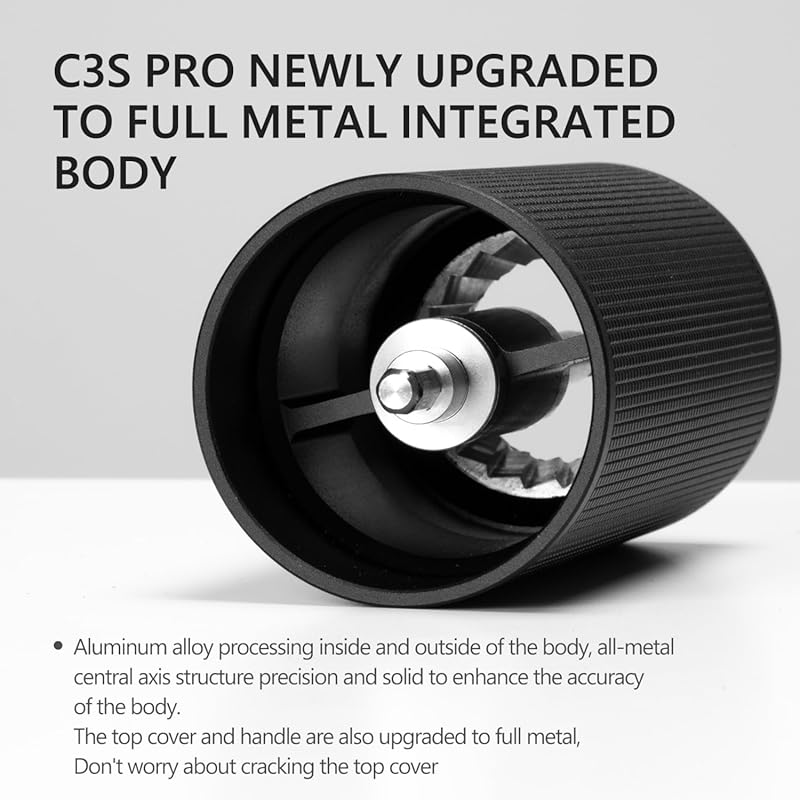
With over 2,100 reviews at 4.8 stars, the C3S has been vetted more thoroughly than any other hand grinder on Amazon. The S2C660 patented conical burr is the star here. It grinds with minimal fines production, meaning you get uniform particles without the dusty residue that cheaper burrs leave behind. The full metal aluminum alloy body fixed the durability problems of the older C2, which had a plastic top cap that was prone to breaking.
The built-in bearing system creates a satisfying momentum effect. Crank the handle and it keeps spinning even after you release it, making the grinding process feel smooth and effortless. The 52mm body fits comfortably in most hands. The 36-level internal adjustment covers espresso through French press.
At $79, the C3S represents the value sweet spot in manual grinding. You're getting burrs and build quality that compete with grinders costing $130+. The internal adjustment mechanism is the main drawback. You need to remove the handle assembly to change settings. Once you find your preferred position for a brew method, this becomes a minor inconvenience rather than a daily frustration.
Pros: - 2,100+ reviews at 4.8 stars, extensively proven - S2C660 burr with minimal fines production - Full metal body solved C2 durability issues - Bearing system for effortless cranking - $79 strong value proposition
Cons: - Internal adjustment requires partial disassembly - 36 levels may limit espresso precision - 25g single-dose capacity - Handle doesn't fold for storage
TIMEMORE Chestnut C3S Pro
The C3S with a foldable handle for travelers and space-conscious brewers.
Everything I said about the C3S applies here. Same S2C660 burr. Same full metal body. Same bearing system. The addition is the foldable crank handle that collapses flat for packing and storage. If you travel with your grinder regularly, that folding handle eliminates the awkward protrusion that catches on bag contents.
At $95, the $16 premium over the standard C3S is entirely for the folding mechanism. If you grind exclusively at home, save the money and buy the C3S. If your grinder travels with you, the foldable design is worth every penny of the difference.
The 2,100+ shared reviews between C3S and C3S Pro models give both listings a deep confidence base. TIMEMORE's quality control is consistent across the lineup. Whether you need a daily home manual coffee mill or a portable travel grinder, the C3S Pro fits both roles.
Pros: - Foldable handle for compact packing - Same proven S2C660 burr - Full metal aluminum body - Shared 2,100+ review base - Versatile for home and travel
Cons: - $16 more than C3S for folding only - Internal adjustment still requires disassembly - Folding mechanism is a potential wear point - 25g capacity limits batch size
TIMEMORE C5 Pro Manual Coffee Grinder
TIMEMORE's newest manual grinder with upgraded burrs and a larger body.
The C5 Pro represents the latest evolution of TIMEMORE's manual grinder line. The patented S2C-042-III stainless steel burrs offer higher precision and efficiency than the S2C660 found in the C3S. The adjustment pitch is finer at 0.031mm per click, giving you 48 levels of coarseness control. That's 12 more levels than the C3S, which matters most for espresso users chasing exact extraction.
The enlarged 53mm body (versus 52mm on the C3S) provides a slightly more comfortable grip and houses a 42mm burr, 4mm larger than the C3S's 38mm. Larger burrs grind faster and more efficiently. The double bearing central axis and built-in momentum bearing carry over from the C3S.
At $110 with reviews shared from the broader TIMEMORE C5 lineup (2,394+ at 4.7 stars), the C5 Pro is well-documented. The question is whether the upgrades justify the $31 premium over the C3S. For espresso-focused grinders, yes. The finer adjustment pitch and larger burr make a measurable difference. For pour-over and French press, the C3S is more than sufficient.
Pros: - S2C-042-III burr with 0.031mm per click precision - 42mm burr size, larger and more efficient - 48 adjustment levels for fine-tuned control - All-metal one-piece enlarged body - Strong review base from TIMEMORE ecosystem
Cons: - $110 premium pricing - Marginal improvement over C3S for non-espresso use - Internal adjustment mechanism - Heavier than the C3S
KINGrinder P0 Lightweight Manual Hand Coffee Grinder
The $22 entry point that makes manual grinding accessible to everyone.
The KINGrinder P0 is proof that you don't need to spend $79 to get a real burr grinder. At $22, it features a genuine SUS420 conical burr with 30 clicks per rotation, giving you 0.0333mm of adjustment per click. The ABS body keeps weight at just 330g. Tool-free disassembly and an included cleaning brush make maintenance simple.
KINGrinder specifically recommends this for drip coffee, Moka pot, and French press. It's not designed for espresso, and I wouldn't try to force it into that role. But for filter brewing methods, the P0 produces genuinely good results at a price point that eliminates any financial barrier to trying manual grinding.
With 257 reviews at 4.8 stars, the P0 has built a loyal following. The ABS plastic body won't feel premium, and the 20g capacity limits you to single doses. But those trade-offs are appropriate at $22. If you've been curious about hand grinding but didn't want to invest $79+ to find out if you enjoy it, the P0 is the answer.
Pros: - $22 makes manual grinding risk-free to try - SUS420 conical burr with 30-click adjustment - Lightweight at 330g for travel - Tool-free disassembly - 257 reviews at 4.8 stars
Cons: - ABS plastic body, not metal - 20g capacity is minimal - Not suitable for espresso - Less stable during grinding due to light weight
Agilive Manual Coffee Grinder
An ultra-compact hand grinder that disappears into your travel bag.
At 6.9 x 2 inches, the Agilive is one of the slimmest manual grinders available. The 38mm stainless steel burr provides 30 clicks per rotation, matching the adjustment precision of grinders costing twice as much. The aluminum alloy body with CNC420 steel core delivers surprising durability for the compact form factor.
The ABS handle keeps weight down. Disassembly for cleaning is tool-free. The grinder covers Moka pot, drip coffee, and French press comfortably. At $35.99 with 66 reviews at 4.8 stars, it's well-received by early buyers.
The Agilive occupies a specific niche: people who want a compact, affordable hand grinder without the brand premium of TIMEMORE. It doesn't have the bearing system or patented burr of the C3S, but it grinds competently and costs less than half the price. For a travel-only grinder or a second grinder for the office, it's hard to beat the value. If you're also checking out manual coffee grinder near me options in stores, you're unlikely to find this kind of performance at $36 offline.
Pros: - Ultra-compact at 6.9 x 2 inches - 38mm stainless steel burr - 30 clicks per rotation - $35.99 competitive pricing - Tool-free disassembly
Cons: - No bearing system for momentum assist - ABS handle may feel basic - Smaller body means more effort per gram - Limited brand recognition and support
TIMEMORE Chestnut C2
The original TIMEMORE bestseller that started the hand grinder revolution.
The C2 holds the record for the most reviews on any manual coffee grinder: 2,649 at 4.7 stars. The 2024 upgraded metal body version uses 420 stainless steel burrs formed through 5-axis CNC machining with 55-58HRC hardness. The dual bearing center axis ensures uniform grinding across every dose.
At $67, the C2 is $12 cheaper than the C3S. The catch: the C3S is better in every meaningful way. The S2C burr produces fewer fines, the full metal body is more durable, and the price difference is minimal. The C2 made sense when it was the only option. Now it occupies an awkward middle ground.
I still include it because 2,649 reviews provide unmatched reliability data. If you find the C2 on sale for $50 or less, it's an excellent deal. At $67, spend the extra $12 for the C3S.
Pros: - 2,649 reviews, deepest review base available - CNC 420 stainless steel burrs - Lightweight at 430g with travel bag - Tool-free disassembly
Cons: - Surpassed by C3S for $12 more - Known top-cap durability issues (pre-2024) - Internal adjustment - No bearing momentum system
TIMEMORE Chestnut C2S
The C2 with a full metal body upgrade and S2C burr.
The C2S fixed the C2's most common complaint: the plastic top cap that cracked on some units. The full metal unibody construction is more durable. The upgraded S2C stainless steel conical burr (38mm, 55-58HRC) produces more consistent grinds with fewer fines than the original C2 burr.
At $75 with 2,394 reviews at 4.7 stars, the C2S has a strong track record. The 36-level adjustment and built-in bearing carry over from the C3S. The 52mm body is comfortable for small hands.
The C2S costs $4 less than the C3S. For that $4 gap, I'd just buy the C3S every time. But if you find the C2S discounted, it's a solid grinder with the same core technology. The C2S and C3S are genuinely close in performance. The C3S edge comes from newer design refinements rather than fundamental performance differences.
For those looking at an Oxo coffee grinder manual alternative, the C2S offers better value in the manual grinder space.
Pros: - Full metal body fixed C2 durability issues - S2C burr with improved consistency - 36-level adjustment - Bearing system for smooth cranking - 2,394 reviews at 4.7 stars
Cons: - Only $4 cheaper than the superior C3S - Internal adjustment requires disassembly - Awkward pricing position in TIMEMORE lineup - 25g capacity
KINGrinder K6 Manual Hand Coffee Grinder
The precision hand grinder for espresso and filter brewing alike.
The K6 stands out with its 16 micrometers per click adjustment and 60 clicks per rotation. That level of precision puts it in espresso-capable territory while still reaching genuine coarseness for French press and drip. The full aluminum body with stainless steel burrs and dual bearing design delivers smooth, consistent results.
The 25-35g capacity is among the largest on this list, handling full French press doses in a single load. The straight handle design provides a different ergonomic experience than traditional crank handles. Some users prefer it. Others find it less natural. Tool-free disassembly and brush cleaning keep maintenance simple.
At $99 with 678 reviews at 4.7 stars, the K6 competes directly with the TIMEMORE C3S Pro at $95. The K6 wins on capacity and adjustment precision. The TIMEMORE wins on brand ecosystem and review volume. Both are excellent grinders. Choose the K6 if you want more capacity and finer adjustment control.
Pros: - 16um per click with 60 clicks per rotation - 25-35g capacity for larger batches - Full aluminum body with dual bearings - 678 reviews at 4.7 stars - Capable across espresso through French press
Cons: - $99 premium pricing - Interior adjustment mechanism - Straight handle takes getting used to - Heavier than ultralight options
Buying Guide: What to Look for in a Manual Coffee Grinder
Burr Quality
CNC-machined stainless steel burrs with hardness ratings of 55-58 HRC are the standard for quality manual grinders. The S2C burr design from TIMEMORE and similar patented burrs from competitors produce fewer fines and more uniform particles than generic burrs.
Adjustment Precision
Clicks per rotation and microns per click determine how finely you can control grind size. 30 clicks per rotation is standard. 48-60 clicks is premium. For espresso, higher click counts matter. For French press, 30 clicks is plenty.
Body Construction
Full aluminum alloy bodies are ideal. They're light, durable, and manage heat well. ABS plastic bodies work for budget grinders. Wood and cast iron add aesthetic appeal but increase weight. Metal bodies with wooden accents offer a nice compromise.
Portability Features
Foldable handles, compact dimensions, and included carry bags all improve portability. Weight matters for travel. The lightest grinders weigh around 285-330g. The heaviest reach 500g+.
Frequently Asked Questions
How long does hand grinding take?
Most manual grinders process a 20g dose in 30-60 seconds for pour-over and 60-90 seconds for espresso. Larger burrs and bearing systems reduce effort and time. With practice, the process becomes a quick morning ritual rather than a chore.
Can manual grinders match electric grinder quality?
for grind consistency per dollar, manual grinders often outperform electrics. A $79 manual grinder produces grinds comparable to a $150-200 electric. The trade-off is speed and effort, not quality.
How do I clean a manual grinder?
Use the included brush to sweep grounds from the burr chamber. Never use water unless the manufacturer says it's safe. Disassemble the burr every 2-4 weeks for thorough dry cleaning. Keep all parts dry before reassembling.
What's the best manual grinder for beginners?
The KINGrinder P0 at $22 is the best starting point. It eliminates financial risk while giving you a genuine burr grinder experience. If you enjoy manual grinding, upgrade to the TIMEMORE C3S at $79.
Internal vs. External adjustment: which is better?
External adjustment is more convenient because you change settings without disassembly. Internal adjustment is simpler mechanically and tends to be more durable. Most TIMEMORE grinders use internal adjustment. If you switch brew methods frequently, external adjustment saves time.
Do I need a gooseneck kettle with a manual grinder?
A gooseneck kettle pairs well with pour-over brewing, not the grinder itself. If you're making French press or AeroPress, any kettle works. The grinder and kettle are separate decisions based on your brew method.
Conclusion
The TIMEMORE Chestnut C3S at $79 remains the best overall manual grinder for its proven S2C burr, full metal body, and 2,100+ reviews confirming reliability. For travelers, the C3S Pro at $95 adds the foldable handle that makes packing effortless. The TIMEMORE C5 Pro at $110 is the upgrade for espresso enthusiasts who need the extra precision. And the KINGrinder P0 at $22 is the risk-free entry point for anyone curious about hand grinding.
Skip the C2 at full price. The C3S is better for $12 more. And if you're torn between TIMEMORE and KINGrinder, you can't go wrong with either brand. Buy based on your specific needs: capacity, adjustment style, budget, and primary brew method.