




Best Single Dose Espresso Grinder: Top Picks for Home Baristas
This post contains affiliate links. If you buy through these links, I may earn a small commission at no extra cost to you. Full disclosure.
Single dose grinding has changed how I make espresso at home. Instead of loading a hopper with beans that slowly go stale, you weigh out the exact dose for each shot and grind it fresh. Zero waste. Maximum freshness. Better shots. The right single dose espresso grinder makes this workflow seamless.
Finding the right grinder in this category means balancing grind consistency, low retention, adjustment precision, and budget. I've tested grinders ranging from $17.99 accessories to $390 premium machines. Some of these are purpose-built for single dosing. Others are standard grinders that happen to work well in a single-dose workflow. I'll be clear about which is which.
If you're new to single dosing, check out my guide on single dose coffee grinder basics. For those who already know they want a dedicated single dose espresso grinder, this roundup covers the best options currently available on Amazon, from budget to premium.
Quick Picks
| Grinder | Best For | Price |
|---|---|---|
| DF64 Gen 2 | Best overall single dose | $390.00 |
| 1Zpresso K-Ultra | Best manual option | $259.00 |
| HiBREW G5 | Best mid-range electric | $189.99 |
| Wirsh Geimori GU38 | Best stepless under $200 | $159.99 |
| Mongdio Electric Burr | Best portable single dose | $74.99 |
Individual Product Reviews
Mongdio Electric Burr Coffee Grinder
A battery-powered single dose grinder with 60 settings, touchscreen controls, and portafilter compatibility.
The Mongdio is fascinating because it runs on a 2600mAh rechargeable battery. That makes it the only truly portable electric single-dose grinder on this list. The 41mm stainless steel conical burrs deliver 60 grind settings, covering espresso through French press. The touchscreen controls let you set grinding time from 5 to 98 seconds, which gives you repeatable doses once you find your sweet spot.
At $74.99, this is the most affordable electric single dose grinder here. It works with both 51mm and 58mm portafilters, and the anti-static slide on the powder outlet prevents clumping. Cleaning is straightforward: press the single-dose hopper to remove residual grounds, wipe clean. With only 2 reviews, this is essentially brand new on the market. That's a risk. The 5-star rating means nothing with a sample size of two. The concept is excellent, and the specs look right. But I'd want to see more user feedback before recommending this to someone spending their only grinder budget. If you want a secondary portable grinder, it's an interesting option.
Pros: - Battery-powered portability (2600mAh) - 60 grind settings from fine to coarse - Works with 51mm and 58mm portafilters - $74.99 is very affordable for electric
Cons: - Only 2 reviews, unproven reliability - 41mm burrs are small for speed - Battery life unknown for daily use
Wirsh Geimori GU38 Single Dose Grinder
A stepless grinder with a 38mm 6-core conical burr and under 0.1g retention.
The GU38 hits the sweet spot for single dose enthusiasts who want precision without spending $300+. The stepless adjustment with 0.01mm micro-adjustments across 65 settings lets you dial in espresso with a level of granularity that stepped grinders can't match. The 38mm 6-core CNC SUS420 stainless steel burr (HRC58 hardness) produces consistent particles with minimal fines.
Retention is the headline feature. Under 0.1g with the included bellows means virtually every bean you grind ends up in your cup. The 96W DC motor runs at a steady 190 RPM, keeping things quiet enough for early mornings. The magnetic dosing cup is a nice touch. At $159.99, it competes directly with the Mongdio on value while offering significantly better build quality and that stepless mechanism. The weak point is the single review on Amazon. As a single dose grinder purchase, you'd normally want more community validation. The specs and build quality suggest this is a genuine contender, though.
Pros: - Stepless 0.01mm micro-adjustment - Under 0.1g retention with bellows - Quiet 190 RPM motor - HRC58 hardness burr set
Cons: - Only 1 review on Amazon - 38mm burr grinds slower than larger alternatives - Newer brand with no track record
Aromaster Conical Burr Coffee Grinder (25 Settings)
A budget espresso-capable grinder with portafilter holder at $69.99.
The Aromaster isn't marketed as a single dose grinder, but its compact design and portafilter holder make it work well in that role. Twenty-five grind settings cover French press through espresso, and the 2-12 cup timer lets you control dosing. The 51-53mm 3-ear portafilter holder means you can grind directly into your basket, cutting out the transfer step.
At $69.99, this is the cheapest grinder on this list that can handle espresso. The upgraded DC motor runs quietly, and the removable upper burr plus hopper make cleaning manageable. Twenty-four reviews at 4.9 stars is promising for a newer product. The limitation for single dosing is the 25-step adjustment. When you're trying to dial in a light roast espresso, the gap between steps 7 and 8 might be too large. You'll sometimes land in a spot where one setting runs too fast and the next runs too slow. For medium and dark roasts, which are more forgiving, the 25 settings work fine.
Pros: - $69.99 with portafilter holder - Quiet DC motor - Easy to clean with removable parts - Good starting point for espresso
Cons: - 25 settings too few for precise espresso dialing - Portafilter holder only fits 51-53mm 3-ear - Not a zero-retention design
HiBREW G5 Single-Dose Espresso Grinder
A metal-bodied grinder with dual-speed motor and 48mm conical CNC burr.
The G5 is purpose-built for single dose espresso. The aluminum alloy housing is sturdy with a textured non-slip surface. What makes it special is the dual-speed motor: 500 RPM for fast grinding or 400 RPM for slow grinding that reduces heat and preserves flavor. That slow mode is genuinely useful when you're working with expensive specialty beans and want to extract every bit of nuance.
The 48mm conical CNC burr offers 36 continuously adjustable settings for espresso, pour-over, and drip. The powder discharger on top of the bean hopper helps clear residual grounds, and the anti-static coating on the outlet keeps things clean. At $189.99 with 35 reviews and 4.8 stars, early adopters are impressed. My only reservation is the 36 grind steps. For a grinder marketed specifically for espresso, I'd prefer 50+. The steps are adequate for most beans, but light roasts can demand finer granularity between settings. Compare this with the Eureka Mignon single dose if you're considering premium options.
Pros: - Dual-speed motor (400/500 RPM) for flavor control - 48mm CNC burr grinds quickly - Metal construction feels premium - Anti-static coating on outlet
Cons: - 36 settings is limiting for espresso precision - $189.99 is mid-range pricing - Powder discharger requires manual pressing
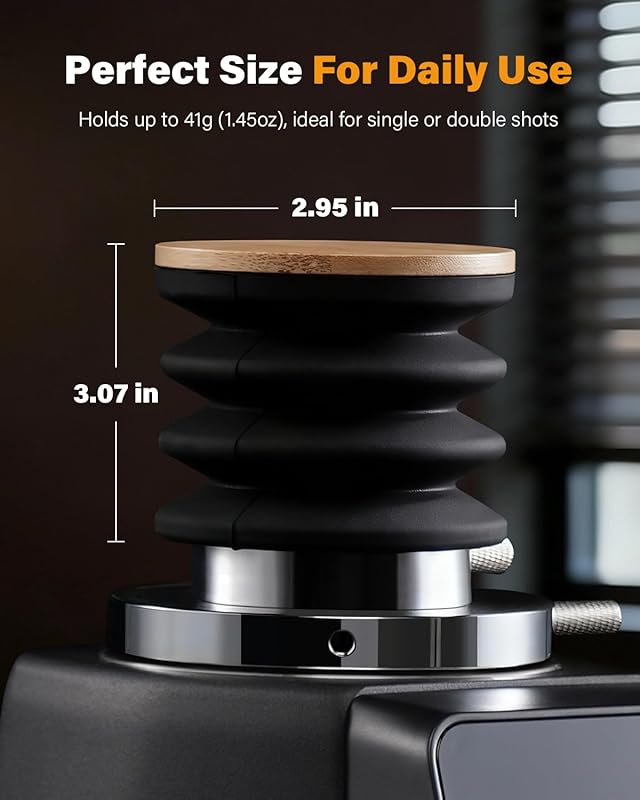
SHARDOR 64mm Single Dose Hopper Bellow
A silicone bellow accessory for the SHARDOR 64mm grinder to enable single dosing.
This isn't a grinder. It's a $17.99 accessory that converts your existing SHARDOR 64mm grinder into a single-dose setup. The silicone bellow with wooden lid lets you blow out leftover grounds after each grind session. Set your grinder to the coarsest setting, turn it on, and pump the bellow up and down. Old grounds clear out so you can switch beans without flavor contamination.
If you already own a SHARDOR 64mm, this is a no-brainer upgrade. The construction uses tough silicone and a sturdy aluminum lid designed for daily abuse. At 30 reviews and 4.8 stars, owners are happy with it. Obviously, this only works with the SHARDOR 64mm grinder. If you don't own one, this is irrelevant. But for SHARDOR owners wanting to start single dosing, $17.99 beats buying a new grinder.
Pros: - $17.99 converts existing grinder to single dose - Durable silicone and aluminum construction - Effectively clears residual grounds - 30 positive reviews
Cons: - Only works with SHARDOR 64mm grinders - Not a standalone grinder - Requires manual pumping each use
1Zpresso K-Ultra Manual Coffee Grinder (Iron Gray)
A premium hand grinder with external adjustment and the K burr for exceptional espresso flavor.
The 1Zpresso K-Ultra is the manual grinder I reach for when I want the best possible espresso flavor without electricity. The specialized K burr produces rich, bright flavors with outstanding consistency. Over 100 clicks at 20 microns each give you extreme precision from the external adjustment dial. No disassembly needed to change settings.
The magnetic catch cup holds 35-40g and snaps into place securely. The foldable handle prevents tipping during storage and makes travel practical with the included carrying case. At $259 with 266 reviews and 4.7 stars, this has significant community backing. For single dose espresso, it's one of the best manual options available. The downside is the manual labor. Grinding 18g of espresso takes about 25-30 seconds with the K-Ultra, which is fast for a hand grinder but slow compared to any electric option. For one person making one espresso per morning, it's pleasant. For a household, it's impractical. See the Eureka single dose for electric alternatives at a similar price point.
Pros: - K burr delivers exceptional espresso flavor - 100+ clicks at 20 microns, extreme precision - External adjustment, no disassembly - 266 reviews with strong ratings
Cons: - $259 is expensive for manual grinding - Physical effort required for each dose - 35-40g capacity limits batch size
DF64 Gen 2 Single Dose Coffee Grinder
The premium benchmark for home single dose grinding with a plasma generator for static elimination.
The DF64 Gen 2 is what serious home baristas buy when they're done compromising. The headline feature is the plasma generator (ionizer) in the exit chute, which eliminates static. Static is the enemy of clean single dosing because it causes grounds to cling to surfaces. The plasma generator solves this problem at the source. The anti-popcorn integrated disc prevents beans from jumping during grinding, which increases speed and consistency.
At $390 with 25 reviews and 4.7 stars, this is the most expensive grinder on the list. That price gets you technology that trickles down from commercial grinders. The included 58mm transparent plastic dosing cup is food-grade and lets you visually inspect your dose. For someone who pulls 2-4 espresso shots daily and wants the best possible single dose workflow, the DF64 Gen 2 is the standard. My only complaint is the price barrier. Most of the grinders on this list cost less than half the DF64's price tag. If you're on a budget, the Wirsh GU38 or HiBREW G5 get you 80% of the way there at a fraction of the cost.
Pros: - Plasma generator eliminates static completely - Anti-popcorn disc for consistent grinding - 58mm dosing cup included - Premium build quality
Cons: - $390 is a significant investment - Only 25 reviews - Requires learning curve for the plasma feature
MiiCoffee GF64 Coffee Grinder
A 64mm flat burr grinder with 100 settings, programmable dosing, and a plasma ionizer at $199.
The MiiCoffee GF64 hits an interesting price point. For $199, you get a 64mm stainless steel flat burr grinder with 100 grind size adjustments (20 macro settings with 5 micro-adjustments each). That's the same level of precision as grinders costing twice as much. The programmable timer supports single shot and double shot modes, plus a manual mode that runs up to 60 seconds.
Like the DF64 Gen 2, it includes a plasma generator (ionizer) inside the exit chute to reduce static. The flat burrs are upgradable to SSP burrs if you want to customize for different flavor profiles, which is a feature typically reserved for $400+ grinders. At only 4 reviews, this is extremely new to the market. The 4.7-star rating from those 4 reviews is meaningless statistically. The spec sheet, though, reads like a budget-friendly version of the DF64. If it delivers on its promises, the GF64 could be the best value in single dose grinding. Proceed with cautious optimism.
Pros: - 100 grind adjustments at $199 - Plasma generator for static reduction - Upgradable to SSP burrs - Programmable single/double shot timer
Cons: - Only 4 reviews, extremely limited data - New brand without established reputation - Flat burrs may need alignment out of box
Buying Guide
What Makes a Good Single Dose Grinder?
Single dose grinders need three things: low retention (under 0.5g), consistent grind at espresso-fine settings, and enough adjustment precision to dial in different beans. Traditional hopper grinders can work for single dosing, but purpose-built machines optimize for these factors.
Retention: Why It Matters
Retention is coffee that stays inside the grinder after you finish. High retention means stale grounds from yesterday mix into today's fresh dose. Good single dose grinders achieve under 0.1g retention with bellows. Budget options might sit at 0.3-0.5g.
Flat Burrs vs. Conical Burrs for Espresso
Flat burrs produce a more uniform particle size, which gives you cleaner, more nuanced espresso. Conical burrs create a bimodal distribution with some fines, resulting in a fuller-bodied shot. Neither is objectively better. It depends on whether you prefer clarity or body in your espresso.
Static: The Single Doser's Nemesis
Static causes grounds to cling to chutes, cups, and portafilters. This messes up your dose accuracy and creates mess. Premium grinders use ionizers or plasma generators to neutralize static. Budget options rely on anti-static coatings or moisture from freshly roasted beans.
How Many Grind Settings Do You Need?
For espresso, more is better. Fifty settings is a practical minimum. Stepless grinders offer infinite adjustment. The difference between settings 25 and 26 on a 50-step grinder can change your shot time by 3-5 seconds. On a 100-step grinder, that change is gentler and more controllable.
FAQ
What does "single dose" mean in coffee grinding?
Single dose means weighing out the exact amount of beans for one brew and grinding them all at once. No beans sit in a hopper between sessions. This maximizes freshness because beans are exposed to air for the minimum possible time.
How much coffee should I single dose for espresso?
Most espresso recipes call for 16-20g of ground coffee. Weigh your beans before grinding. The standard starting point is 18g for a double shot, then adjust based on taste and your specific basket size.
Do I need a WDT tool with a single dose grinder?
A WDT (Weiss Distribution Technique) tool breaks up clumps in your portafilter before tamping. Even the best single dose grinders produce some clumping. A WDT tool costs $10-15 and noticeably improves shot consistency.
Can I use a single dose grinder for pour-over?
Yes, most single dose grinders adjust coarse enough for pour-over. Check the grind range before buying. Espresso-focused grinders sometimes max out at a medium grind, which isn't coarse enough for French press.
How do bellows help with retention?
Bellows push air through the grinding chamber after your last bean exits. This blast of air dislodges grounds clinging to burrs and chute walls, pushing them into your cup. Most bellows reduce retention from 1-2g down to under 0.1g.
Is a $390 grinder worth it for home use?
If you pull 2+ espresso shots daily and enjoy dialing in different beans, yes. The DF64 Gen 2's plasma generator and build quality will last years. If you drink espresso a few times a week, the $160-200 options deliver most of the same quality.
Conclusion
For the best single dose experience without budget constraints, the DF64 Gen 2 at $390 sets the standard with its plasma generator and anti-popcorn technology. The MiiCoffee GF64 at $199 offers similar specs at nearly half the price if you're willing to take a chance on a newer product. For manual grinding purists, the 1Zpresso K-Ultra at $259 delivers exceptional espresso flavor with 100+ precision clicks. And for those entering single dose grinding on a budget, the Wirsh Geimori GU38 at $159.99 offers stepless adjustment and under 0.1g retention that punches well above its price.