


Niche Grinder Price: What Coffee Grinders Actually Cost in 2024
This post contains affiliate links. If you make a purchase through these links, I may earn a small commission at no extra cost to you. This helps support the site and allows me to keep creating honest reviews.
The term "niche grinder" gets thrown around a lot in coffee circles, usually referring to the Niche Zero. But the broader question people are really asking is: what does a quality coffee grinder actually cost? And is it worth spending $200, $500, or even $1,200 on one?
I have been through grinders at every price tier, from $26 blade choppers to $1,200 commercial flat-burr machines. This guide breaks down what you get at each price point so you can make an informed decision. Whether you are eyeing a Niche Zero or just trying to find the best grinder your budget allows, these are the options worth considering.
The short answer is: you can get excellent coffee from a grinder under $200. But if you are chasing espresso perfection or want a grinder that will last a decade without losing consistency, spending more is justified. For a more comprehensive look at the Niche Zero Grinder specifically, check our dedicated review. This page covers alternatives across the full price range.
Quick Picks
| Grinder | Price Tier | Best For |
|---|---|---|
| Eureka Atom Specialty 75 | $1,199 (Premium) | Commercial-grade espresso |
| Breville Smart Grinder Pro | $199.95 (Mid-Premium) | Versatile home setup |
| 1Zpresso X-Ultra | $159 (Mid-Range Manual) | Pour-over enthusiasts |
| Ollygrin Burr Grinder | $79.99 (Budget Burr) | Affordable daily driver |
| BLACK+DECKER One Touch | $25.99 (Budget Blade) | Absolute minimum spend |
Individual Product Reviews
Eureka Atom Specialty 75
Commercial-grade 75mm flat burrs in a home-sized package. This is the top end.
The Eureka Atom 75 packs the same 75mm flat burrs found in the Eureka Olympus and Mythos commercial grinders. That puts it in the same league as equipment used in professional cafes. The burr size delivers best-in-class grind times, meaning you spend seconds, not minutes, waiting for your dose.
Sound insulation is exceptional. Eureka's signature gaskets and motor mounts make the Atom 75 one of the quietest commercial-grade grinders on the market. The near-silent operation is a genuine selling point for home use, where grinding noise at 6 AM matters.
The stepless grind adjustment offers nearly infinite settings. You dial it in by feel and stop wherever the shot tastes best. Timed dosing lets you program single and double shot doses, plus a manual grind mode for grinding directly into your portafilter. The short hopper design (this is the short hopper variant) reduces headroom requirements.
At $1,199, the Atom 75 costs more than most home espresso machines. This is a grinder for someone who has decided that coffee quality is a priority and wants equipment that will last 10+ years of daily use. The Niche Coffee Grinder competes in this tier as well, and either would serve an enthusiast well. If you are pulling 2-4 shots daily on a serious espresso machine, the Atom 75 is a worthy companion.
Pros: - 75mm flat burrs matching commercial equipment - Near-silent operation with sound insulation - Stepless grind with infinite adjustment - Programmable timed dosing for single and double shots
Cons: - $1,199 is a significant investment - Only 5 Amazon reviews, limited community feedback - Short hopper limits bean capacity - Overkill for anyone not brewing espresso daily
Breville Smart Grinder Pro BCG820BTR
The most popular mid-premium grinder on Amazon, and for good reason.
With 6,820 reviews and a 4.5-star rating, the Smart Grinder Pro has more real-world validation than almost any other grinder in its class. Breville's 60 grind settings cover everything from espresso-fine to coarse cold brew. The Dosing IQ feature lets you program grind time in 0.2-second increments, which is remarkably precise for a $200 grinder.
The conical burr set produces consistent grounds across its range. The grinder can dose directly into a portafilter, airtight container, gold tone filter, or paper filter, giving you flexibility regardless of your brewing method. Pre-programmed settings make it accessible for beginners, while the manual controls satisfy experienced users.
At $199.95 in the Black Truffle finish, this is the Niche Grinder alternative that most people end up buying when they decide the Niche Zero's price is too steep. The Smart Grinder Pro does not match a Niche Zero in single-dose performance, but it handles hopper-based daily grinding with ease and covers more brew methods.
The retention is the main weakness. Grounds get trapped in the chute, and when you switch between grind settings, you get cross-contaminated grounds for the first dose or two. Single-dose purists will be frustrated. Daily-driver users will not notice.
Pros: - 60 grind settings with Dosing IQ precision - 0.2-second timer increments - Multiple grind destinations (portafilter, container, filter) - 6,820+ reviews confirm long-term reliability
Cons: - Noticeable retention in the chute - Not ideal for single-dose workflow - Conical burrs produce slightly less uniformity than flat - 18oz hopper capacity is large but beans go stale sitting in it
1Zpresso X-Ultra Manual Coffee Grinder
A slim, foldable manual grinder designed specifically for pour-over clarity.
The X-Ultra uses a unique heptagonal (7-sided) burr that produces a light, sweet flavor profile optimized for filter brewing. This is a pour-over grinder first and foremost. It can handle espresso in a pinch, but its design prioritizes the clarity and sweetness that pour-over fans love.
The innovative external adjustment system offers 60 steps per rotation with an easier calibration process than previous 1Zpresso models. The slim body and foldable handle make it genuinely portable, fitting into bags and small spaces. The magnetic catch cup holds 25-30g and detaches for easy transfer.
At $159, the X-Ultra competes with entry-level electric burr grinders while offering superior grind consistency for filter methods. The hand grinding ritual takes about 30-40 seconds for a single pour-over dose.
Cleaning is tool-free. Disassemble the pieces, brush them out, and reassemble. A cleaning brush and blow bulb come included. For a more versatile manual option that also handles espresso well, the Niche Zero Coffee Grinder is the comparison, but at roughly double the price of the X-Ultra, you are paying for versatility.
Pros: - Heptagonal burr optimized for pour-over flavor - 60-step external adjustment with easy calibration - Slim, foldable, portable design - Magnetic catch cup for clean workflow
Cons: - Pour-over focused, less versatile for espresso - Manual grinding requires effort - 25-30g capacity limits batch size - Slim body may feel less sturdy than wider grinders
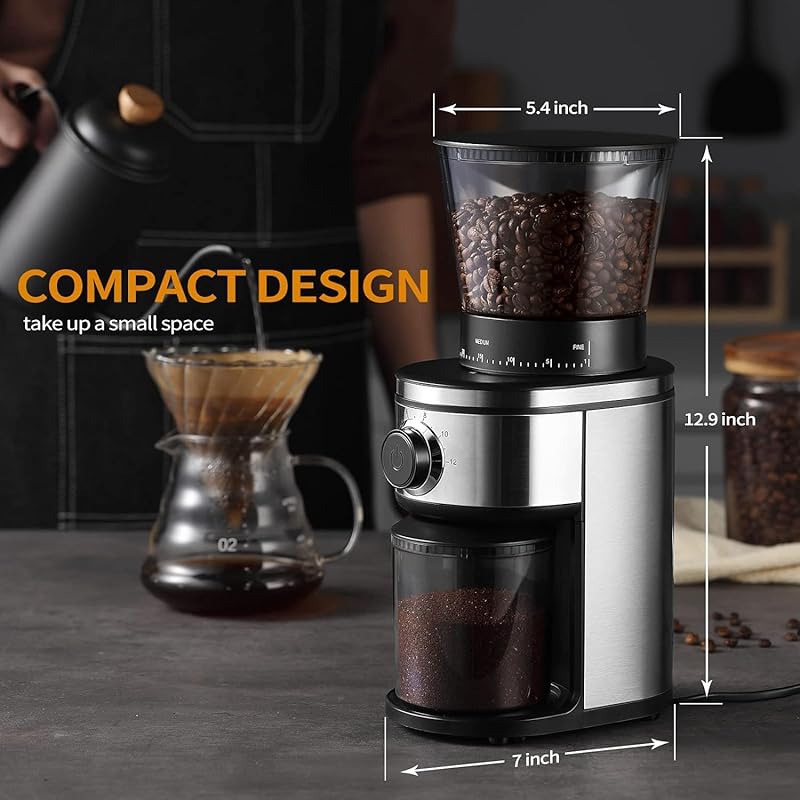
Ollygrin Burr Coffee Grinder BG702S-PG
Solid daily-driver burr grinding for under $80.
The Ollygrin packs a 40mm stainless steel conical burr into a $79.99 body with 30 grind settings, a large 10oz bean hopper, and a gear reduction motor. The gear reduction is the detail that matters. It slows the grinding speed, which generates less heat from friction and preserves the coffee's flavor and aroma. Fast-spinning motors cook the oils right off your beans.
30 settings cover espresso through French press. The auto-locking hopper system prevents beans from spilling when you remove the hopper for refilling or storage. With 1,663 reviews at 4.5 stars, this is a well-proven product.
For $79.99, the Ollygrin is the best electric burr grinder for someone who does not want to think too hard about their grinder. Load beans, pick a setting, grind. The results are consistent enough for drip, pour-over, and basic espresso. It will not compete with the Breville Smart Grinder Pro's 60 settings, but it costs less than half as much.
Pros: - 40mm conical burrs for consistent grinding - Gear reduction motor preserves flavor - Auto-locking 10oz hopper - $79.99 is excellent value
Cons: - 30 settings may not be granular enough for espresso - No programmable timer - Retention is moderate - Build quality is adequate, not premium
BLACK+DECKER One Touch Coffee Grinder
The entry point. Blade grinding at its most basic.
At $25.99 with over 18,000 reviews, the BLACK+DECKER One Touch is the most purchased coffee grinder on Amazon. The stainless steel blades chop beans with push-button simplicity. The lid-locking safety feature prevents the blades from spinning unless the lid is secured.
Let me be direct: blade grinders produce inconsistent particle sizes. You get powder and chunks in the same batch. For drip coffee and French press, this matters less because those brew methods are forgiving. For espresso, it matters a lot.
The BLACK+DECKER also handles herbs, spices, grains, and nuts, making it a versatile kitchen tool beyond coffee. At $26, the barrier to entry is about as low as it gets.
If this is your first grinder, it will still produce better coffee than pre-ground. Fresh-ground beans, even imperfectly ground, taste better than beans that were ground weeks ago. But budget $80+ when you are ready to upgrade to a burr grinder and taste the real difference.
Pros: - $25.99 is the lowest price on this list - 18,000+ reviews confirm basic reliability - Simple one-button operation - Doubles as spice and herb grinder
Cons: - Blade grinder with inconsistent particle sizes - No grind settings - Poor for espresso - No capacity markings or timer
Buying Guide: How Much Should You Spend on a Coffee Grinder?
Under $30 (Blade Grinders). You get basic coffee grinding that is better than pre-ground. Inconsistent particles mean uneven extraction, but for drip coffee, the freshness advantage still makes it worthwhile. Expect to replace blade grinders every 2-3 years.
$50-$100 (Entry Burr Grinders). This is where coffee quality takes a real jump. Conical burr grinders with 25-40 settings produce uniform grounds that extract evenly. The Ollygrin at $79.99 represents this tier well. Good enough for daily drip, pour-over, and beginner espresso.
$100-$250 (Mid-Range Burr Grinders). Finer grind control, better build quality, and features like programmable timers. The Breville Smart Grinder Pro at $199.95 and 1Zpresso X-Ultra at $159 are flagship products in this range. Serious home coffee setups should budget for this tier.
$500-$1,500 (Premium/Commercial). Equipment that matches what cafes use. The Eureka Atom 75 at $1,199 and the Niche Zero fall here. Built to last a decade, with grind quality that extracts every drop of flavor from specialty beans. Only justified if coffee is a daily passion.
Heat and Speed. Slow-grinding motors (under 500 RPM) preserve flavor by reducing heat. Fast motors grind quicker but can degrade aromatic compounds. This matters more with light roasts, which are more heat-sensitive.
Frequently Asked Questions
Why is the Niche Zero so expensive? The Niche Zero uses 63mm Mazzer flat burrs in a single-dose design with near-zero retention. The engineering, materials, and UK manufacturing justify its premium. That said, grinders like the Breville Smart Grinder Pro and Eureka Atom offer competitive quality at different price points.
Is a $200 grinder better than a $25 grinder? Dramatically. The jump from blade to burr grinding is the single biggest improvement you can make to your coffee. A $200 burr grinder produces uniform particles that extract evenly, resulting in balanced, flavorful coffee instead of the muddled inconsistency of blade-ground beans.
Do I need to spend $1,000+ on a grinder? No. Most home brewers are well-served by grinders in the $100-200 range. Premium grinders like the Eureka Atom 75 are for enthusiasts who want commercial-grade performance and plan to use the same grinder for 10+ years.
How long do coffee grinder burrs last? Steel burrs typically last 500-1,000 pounds of coffee, which translates to 3-8 years of daily home use. Higher-grade burrs (like the Eureka's 75mm) last even longer. Ceramic burrs last longer on paper but chip more easily.
Should I buy a manual or electric grinder? Manual grinders offer better grind quality per dollar spent but require physical effort. Electric grinders are faster and more convenient. If you brew 1-2 cups daily and enjoy the ritual, manual is excellent. For households brewing 4+ cups, electric is more practical.
What is retention and why does it matter? Retention is the amount of ground coffee that stays trapped inside the grinder after each use. High retention means stale grounds contaminate your next dose. Single-dose grinders like the Niche Zero minimize this. Hopper-based grinders have more retention but are fine if you use the same beans daily.
Conclusion
Coffee grinder pricing follows a clear pattern: every dollar you spend up to about $200 produces a noticeable improvement in your cup. Beyond $200, the improvements become more subtle and matter mainly to espresso enthusiasts.
For most people, the Breville Smart Grinder Pro at $199.95 is the sweet spot. It covers every brew method, has 60 precise settings, and over 6,800 reviews confirm its reliability.
Budget-conscious buyers should start with the Ollygrin at $79.99 for burr quality that transforms your drip coffee. And if espresso perfection is your goal and budget is flexible, the Eureka Atom Specialty 75 at $1,199 brings cafe-grade grinding to your kitchen counter.