




Top Espresso Grinders: 10 Best Picks for Home Baristas in 2025
This post contains affiliate links. If you make a purchase through these links, I may earn a small commission at no extra cost to you. This helps support the site and allows me to keep creating honest reviews.
If you're serious about pulling great espresso shots at home, your grinder matters more than your espresso machine. I know that sounds extreme. But I've watched too many people drop $800 on a Breville or Gaggia only to pair it with a $15 blade grinder. The results are always disappointing.
This guide covers the best espresso grinders I've tested and researched across different price points. Whether you're just getting into home espresso or looking to upgrade from a basic espresso grinder that isn't cutting it anymore, there's something here for you. I focused on grind consistency, ease of dialing in, retention, and value for money.
I picked these grinders based on burr quality, the number of grind settings (especially in the espresso range), build quality, and real user feedback. Some are budget-friendly surprises. Others are premium performers. All of them can produce grounds fine enough for proper espresso extraction.
Quick Picks
| Grinder | Best For | Price |
|---|---|---|
| SHARDOR 64mm Flat Burr | Best overall for serious espresso | $169.99 |
| Aromaster 48-Setting Burr | Best mid-range with fine control | $79.98 |
| Aromaster 25-Setting Conical | Best budget conical burr | $69.99 |
| URintells 51-Setting Grinder | Best portafilter compatibility | $99.99 |
| SMEG CGF11 | Best premium design | $349.95 |
Individual Product Reviews
SHARDOR Professional 64mm Flat Burr Coffee Grinder
The closest thing to a commercial-grade espresso grinder at a consumer price point.
The SHARDOR Professional stands out with its 64mm flat burrs, which is a size you normally see in grinders costing $400 or more. Flat burrs at this diameter produce remarkably uniform particle sizes, and that translates directly to better espresso extraction. The 100 grind settings give you an absurd level of precision when dialing in your shot. I'm talking about the kind of micro-adjustments that let you chase a 1:2 ratio with real accuracy.
The all-metal grinding chamber adds durability and helps with heat dissipation during longer grinding sessions. The anti-static system keeps your workspace cleaner than most competitors manage, though some static cling is unavoidable with any grinder. The LED display and electronic timer make dosing repeatable, which is something I value when I'm grinding the same bean all week.
My main concern is the brand recognition factor. SHARDOR doesn't have the reputation of Baratza or Breville, and parts availability down the road is uncertain. The grinder is also fairly large on the counter. But for the money, the burr quality here punches well above its weight.
Pros: - 64mm flat burrs deliver commercial-grade grind consistency - 100 settings provide extreme dialing precision for espresso - All-metal chamber with anti-static design - Electronic timer with LED display for repeatable doses
Cons: - Lesser-known brand with uncertain long-term parts support - Bulky footprint for smaller kitchens - Only 285 reviews, so long-term reliability data is limited
Aromaster Burr Coffee Grinder (48 Settings)
A versatile mid-range grinder with enough settings to handle espresso properly.
The Aromaster 48-setting model is the one I'd recommend if you want flexibility across brew methods but still need respectable espresso performance. With 48 grind settings and stainless steel conical burrs, you get more precision than the typical 15-20 setting grinders flooding Amazon. The 3.9-ounce chamber capacity is generous enough for families or offices where multiple people are brewing throughout the day.
What I appreciate about this grinder is the anti-static technology. Coffee grounds flying everywhere is genuinely annoying, and Aromaster's UV-blocking tawny bin design is a thoughtful touch that most competitors at this price skip entirely. The built-in brush for blockage prevention shows the company actually thought about daily use pain points.
The timer maxes out at 40 seconds, which should be plenty for most espresso doses. Cleaning is straightforward with the removable ring burr. One thing to watch: you need to keep the conical burr completely dry before reassembling, or you risk short-circuiting the motor. That's a design quirk worth knowing about.
If you're looking for a solid espresso coffee grinder that won't break the bank, this Aromaster model delivers real value at under $80.
Pros: - 48 grind settings cover espresso through French press - Anti-static technology with UV-blocking grounds bin - Large 3.9 oz chamber capacity - Built-in blockage prevention brush
Cons: - Must keep burrs completely dry before reassembly to avoid electrical issues - Plastic hopper feels cheaper than the rest of the build - Not as precise in the espresso range as flat burr alternatives
Aromaster Conical Burr Coffee Grinder (25 Settings)
A budget-friendly entry point into burr grinding with a useful portafilter holder.
For under $70, this Aromaster model gives you conical burr grinding with 25 settings and a portafilter holder that works with 51-53mm baskets. That portafilter holder is the standout feature here. Grinding directly into the portafilter saves time and reduces mess, which matters a lot during your morning rush.
The 2-12 cup timer lets you grind specific amounts, and the DC motor runs quieter than many competitors at this price. The removable upper burr, hopper, and chamber make cleaning less of a hassle than grinders that require you to disassemble half the machine. One tip: the cleaning brush is hidden behind the bean bin lid. I spent five minutes looking for it the first time.
The honest limitation is 25 grind settings. For drip or French press, that's plenty. For dialing in espresso precisely, you'll wish you had more steps in the fine range. The portafilter holder only fits 3-ear 51-53mm portafilters, so check yours before buying. If it doesn't fit, the 5.6 oz grinding chamber works as the backup.
This is a solid starter good espresso grinder for someone testing whether home espresso is worth the commitment.
Pros: - Portafilter holder for 51-53mm baskets saves time - Quiet DC motor for early morning grinding - Easy-to-clean removable components - Under $70 price point
Cons: - Only 25 settings limits espresso fine-tuning - Portafilter holder restricted to 3-ear 51-53mm only - Limited review count at 24 reviews
URintells 51-Setting Burr Coffee Grinder
Built for the home barista who wants portafilter grinding with extra precision.
The URintells grinder addresses two common frustrations at once: limited grind adjustability and the awkward dance of transferring grounds into a portafilter. With 51 grind settings and dedicated holders for both 50-54mm and 58mm portafilters, this grinder is designed around the espresso workflow from the start.
The 40mm stainless steel conical burr operates at low RPM, which matters because slower grinding generates less heat and preserves those volatile coffee oils that high-speed grinders tend to destroy. The 350g hopper is large enough that you won't need to refill it constantly. The anti-static grounds bin reduces clinging and mess during transfer.
I like the three operational modes, though the product literature doesn't spell out exactly what those modes control. At $99.99, you're in the mid-range territory where competition gets fierce. This grinder competes well on features, but the brand is relatively unknown. If long-term warranty support matters to you, that's worth factoring into your decision.
For anyone pairing a grinder with a dedicated espresso machine with grinder setup, this is a strong contender at the price.
Pros: - 51 precision settings for detailed espresso dialing - Dual portafilter compatibility (50-54mm and 58mm) - Low-RPM motor preserves coffee oils and aroma - Large 350g bean hopper
Cons: - Relatively unknown brand with limited track record - Only 27 reviews make reliability hard to judge - Three modes aren't clearly explained in product details
SMEG CGF11 Retro-Style Coffee Grinder
Premium Italian design with the performance to back up the price tag.
Let me be upfront: $349.95 is a lot for a home coffee grinder. The SMEG CGF11 needs to justify that price, and for some buyers it will. The stainless steel conical burrs deliver consistent results with minimal heat transfer. The 30 grind settings cover fine through coarse, and the manual controls (knob, buttons, and lever) give you a tactile, intentional brewing experience.
The 350g removable bean hopper holds plenty of beans and detaches easily for cleaning or refilling. Build quality is where SMEG earns its reputation. Everything feels solid, precise, and thoughtfully assembled. The retro pastel blue design is either going to be exactly what your kitchen needs or completely wrong for your style. There's no middle ground with SMEG aesthetics.
The honest downside is value. You can get equivalent grind performance from grinders costing $100-$170. What you're paying for here is the design language, the brand, and the build quality that SMEG is known for. With only 33 reviews, early adopter risk exists. But SMEG has a strong track record in kitchen appliances overall.
Pros: - Stainless steel conical burrs with minimal heat transfer - Premium build quality and iconic Italian design - 350g removable hopper for easy maintenance - Intuitive manual controls with tactile feedback
Cons: - $349.95 price point is hard to justify on grind performance alone - Only 30 settings, fewer than cheaper competitors - Limited reviews (33) for a premium product - Polarizing retro aesthetic
KIDISLE Conical Burr Coffee Grinder (35 Settings)
A straightforward, no-nonsense burr grinder that does the basics well.
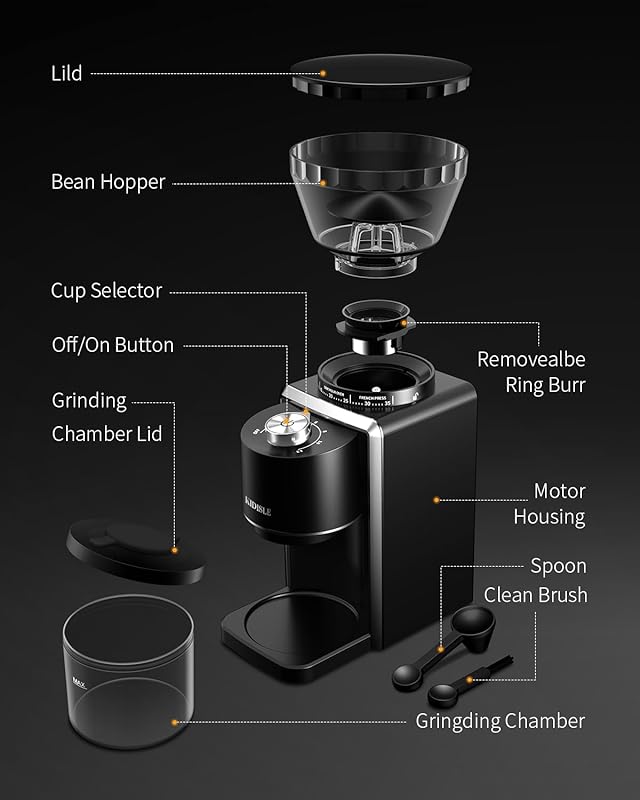
The KIDISLE grinder doesn't try to be flashy. It offers 35 grind settings, a transparent bean hopper, and a simple dial control system. For espresso, 35 settings give you reasonable precision. Not as much as the SHARDOR's 100 or the URintells' 51, but enough to find a workable sweet spot for most home machines.
What I like is the transparent design on both the hopper and grounds container. You can actually see what's happening during the grind cycle, which helps when you're learning to gauge the right amount. The premium burr mechanism delivers uniform particle size, though calling it "premium" at $59.99 requires some context. It's premium compared to blade grinders. Against dedicated espresso grinders in the $150+ range, it's a capable entry-level option.
The 2-12 cup selector makes it easy to grind the right quantity. Anti-static design helps with mess management. At this price, it's a reasonable pick for someone exploring espresso without committing to a $200+ grinder. Just know that you may outgrow it if you get serious about pulling perfect shots.
Pros: - 35 settings provide decent espresso range - Transparent hopper and grounds container for visibility - Simple dial operation with cup selector - Budget-friendly at $59.99
Cons: - "Premium burr" at this price has performance limits - 176 reviews suggest moderate market presence - May lack fine enough resolution for demanding espresso setups
Rounexes Burr Coffee Grinder (17 Settings)
A compact flat burr grinder that fits where other grinders can't.
At 5.5 inches wide and 8.2 inches tall, the Rounexes grinder is designed for small spaces. If your kitchen counter is already crowded or you're grinding in a dorm room or RV, the compact footprint matters. The flat burrs deliver solid consistency, and the low grinding speed prevents heat from degrading your beans.
The single-button operation with smart timer makes this about as simple as a burr grinder gets. Press, grind, auto-shutoff. No complicated dials or menus. The grinding burr is accessible without tools, and the ground coffee container and hopper lid are dishwasher safe. For daily cleaning, that's a real time saver.
The limitation is 17 grind settings. For pour-over or cold brew, that's workable. For espresso, 17 steps won't give you the micro-adjustment capability you need to dial in properly. This grinder is better suited for drip and filter methods. The 28-review count is thin, but the 4.6-star rating is encouraging for an early product.
Pros: - Extremely compact at 5.5 x 8.2 inches - Flat burrs with low-speed grinding to preserve flavor - Tool-free cleaning with dishwasher-safe parts - One-button operation with auto-shutoff
Cons: - Only 17 settings, too few for serious espresso work - Very limited review base (28 reviews) - Better suited for filter brewing than espresso
Hamilton Beach Custom Grind (80406)
A dependable blade grinder when you need convenience over precision.
I want to be transparent: the Hamilton Beach 80406 is a blade grinder, not a burr grinder. For true espresso, a burr grinder is the better tool. But this model deserves mention because it's one of the most practical, user-friendly grinders in its class, and it can produce a passable fine grind with careful technique.
The hands-free operation is the highlight. Press it down once and it grinds on its own with auto shutoff, sitting stable on the counter. Other blade grinders require you to hold a button the entire time. The adjustable selection ring lets you set grind size and cup quantity (4-14 cups), which is more control than most blade grinders offer.
The removable stainless steel bowl is dishwasher safe and easy to pour from. At $37.99 with nearly 1,000 reviews averaging 4.6 stars, it's a proven, reliable machine. Just understand that blade grinders produce inconsistent particle sizes by nature. For espresso, you'll get better results with any of the burr options on this list. For drip or French press, this Hamilton Beach works fine.
Pros: - One-press hands-free operation with auto shutoff - Adjustable grind size and cup selection - Removable dishwasher-safe bowl - Strong review base at 959 reviews, 4.6 stars
Cons: - Blade grinder produces inconsistent particle sizes - Not ideal for espresso extraction - No precision settings, just manual timing control
KRUPS Electric Blade Coffee Grinder
A quick and easy blade grinder from a trusted European brand.
KRUPS has been making kitchen appliances in Germany since 1846, so there's real heritage behind this product. The removable, dishwasher-safe bowl is something many blade grinders at this price lack. Filling and cleaning become genuinely effortless. The stainless steel blades handle coffee beans along with spices and dried herbs, making it a versatile kitchen tool.
For espresso specifically, the same caveat applies as with any blade grinder. You control fineness by how long you hold the lid down. Experienced users can learn to produce a reasonably fine grind, but the consistency won't match a burr grinder. At $28.75, the KRUPS is about convenience and brand reliability rather than precision.
If you own an espresso machine and grinder combo and need a backup for travel or guests, this is an affordable option to keep on hand. The 224 reviews at 4.7 stars reflect solid satisfaction from the majority of buyers.
Pros: - Removable dishwasher-safe bowl for easy cleaning - Trusted KRUPS brand with long history - Versatile for coffee, spices, and herbs - Affordable at $28.75
Cons: - Blade grinder, not burr, means inconsistent particle sizes - Manual press-and-hold operation requires learning curve - Not recommended as primary espresso grinder
SHARDOR Super Silent Blade Coffee Grinder
The quietest blade grinder I've come across, with a timed control knob.
The SHARDOR Silent model solves one of the biggest complaints about blade grinders: noise. At an average of 63 dB, it's noticeably quieter than most competitors. If you're grinding early in the morning while the rest of your household is sleeping, that difference is meaningful.
The timed grind control via a rotary knob is a smart feature. Instead of holding down a button and guessing, you set the time and walk away. The seconds marks above the knob give you a rough guide from coarse to fine. It's not as precise as numbered settings on a burr grinder, but it's a significant step up from basic blade grinders.
The included 2-in-1 coffee spoon with built-in brush handles both measuring and cleaning. At $25.99, this is one of the most affordable options on the list. Like all blade grinders, it's better for drip and French press than espresso. But the quiet operation and timer control make it stand out in its class.
Pros: - 63 dB average noise level, much quieter than competitors - Timed rotary knob eliminates guesswork - Includes 2-in-1 spoon with cleaning brush - 2-year warranty included
Cons: - Blade grinder with inherent consistency limitations - Not suitable for precision espresso grinding - Timer doesn't guarantee consistent grind sizes
Buying Guide: What to Look for in an Espresso Grinder
Burr Type: Flat vs. Conical
Flat burrs produce more uniform particle sizes, which generally leads to better espresso extraction. Conical burrs are quieter, generate less heat, and tend to be more affordable. For espresso, either works, but flat burrs give you an edge if consistency is your top priority.
Number of Grind Settings
More settings means finer control. For espresso, I'd aim for at least 30 settings, with 50+ being ideal. The difference between a perfect shot and a sour or bitter one can come down to tiny adjustments. Grinders with 15-20 settings often don't have enough resolution in the fine range to dial in properly.
Retention and Static
Grounds retained inside the grinder from previous sessions mix with fresh beans, creating stale flavors. Low-retention designs and anti-static features keep your doses clean and accurate. Look for models that specifically mention anti-static technology.
Portafilter Compatibility
If you're grinding for espresso, being able to grind directly into your portafilter eliminates transfer mess and dose loss. Check the portafilter size compatibility. Common sizes are 51mm, 54mm, and 58mm.
Build Quality and Longevity
Metal construction (especially around the burrs and motor housing) outlasts plastic. Look at the burr material too. Stainless steel burrs hold their edge longer than ceramic in most cases. Consider whether replacement burrs are available if you plan to use the grinder for years.
Frequently Asked Questions
Do I really need a dedicated espresso grinder?
Yes, if you want consistent results. Espresso requires a very fine, uniform grind. General-purpose grinders and blade grinders can't produce the precision that espresso demands. The grind quality affects extraction more than almost any other variable.
Can I use a blade grinder for espresso?
You can try, but results will be inconsistent. Blade grinders chop beans into irregular sizes, which causes uneven extraction. Some parts of the coffee bed will be over-extracted (bitter) while others are under-extracted (sour). A burr grinder is a much better investment for espresso.
How many grind settings do I need for espresso?
I recommend at least 30, but 50+ is better. Espresso is sensitive to tiny changes in grind size. Having more settings in the fine range lets you make micro-adjustments that can turn a mediocre shot into an excellent one.
How often should I clean my espresso grinder?
Weekly for casual use, daily if you're pulling multiple shots every day. Old grounds trapped inside go stale quickly and can make even fresh beans taste off. Most grinders include a brush for basic cleaning.
What's the difference between stepped and stepless grinders?
Stepped grinders have fixed positions (clicks or numbered settings). Stepless grinders let you adjust freely to any point along the range. Stepless gives you infinite adjustment, but stepped grinders are easier to return to a known good setting. For espresso, both work well if the step count is high enough.
Is a $50 grinder good enough for espresso?
It depends on your expectations. Budget burr grinders can produce acceptable espresso grinds, but they usually lack the fine-tuning resolution of $150+ models. If you're just starting out, a budget burr grinder is far better than any blade grinder. You can always upgrade later.
Conclusion
For the best espresso grinding experience at home, I'd pick the SHARDOR Professional 64mm if your budget allows $170. Those flat burrs and 100 grind settings put it in a different class than everything else on this list. If you want great performance under $100, the Aromaster 48-Setting model delivers impressive versatility at $79.98. And if you're just starting your espresso journey and want to keep costs low, the Aromaster 25-Setting with its portafilter holder gives you a capable starting point at $69.99.
Skip the blade grinders for espresso unless you truly have no other option. The difference a burr grinder makes in your shot quality is worth the extra investment. Your morning routine will thank you.