




Varia VS3 Alternatives: 8 Best Coffee Grinders Worth Considering
This post contains affiliate links. If you purchase through these links, I may earn a small commission at no extra cost to you. This helps support the site and allows me to keep reviewing coffee gear.
The Varia VS3 has earned a reputation as one of the better single-dose espresso grinders in the $300-400 range. But it is not the only option worth considering. Whether you are looking for something cheaper, something with different features, or simply exploring what else is available before committing, this guide covers the best alternatives across a wide price range.
I have tested and compared grinders from $79 to $399 that compete in the same space as the Varia VS3. Some prioritize espresso performance. Others offer more versatility across brewing methods. If you are shopping for a quality coffee grinder and the VS3 caught your eye, one of these might be the better fit for your setup and budget.
My focus was on grind consistency, retention, ease of dialing in, build quality, and value relative to the VS3. I also considered how well each grinder handles single-dosing, since that is a primary use case for anyone looking at this category.
Quick Picks
| Grinder | Best For | Price |
|---|---|---|
| MiiCoffee DF64 II | Best single-dose alternative to the VS3 | $399.00 |
| Bincoo Espresso Grinder | Best magnetic design under $300 | $289.00 |
| SHARDOR 64mm Flat Burr | Best value with 100 settings | $169.99 |
| Breville Smart Grinder Pro | Best all-around programmable grinder | $179.96 |
| Tuni G1 | Best budget single-dose option | $89.00 |
Individual Product Reviews
MiiCoffee DF64 II Single Dosing Coffee Grinder
The closest competitor to the Varia VS3 in both performance and philosophy.
The DF64 II is a true single-dose grinder with near-zero retention (under 0.1 gram). That is the number that matters most for single-dosing. The 64mm flat burrs are custom-made stainless steel, and the new Version 2.5 features a redesigned inner chute with plasma generator probes wrapping around the interior for better static control.
What makes the DF64 II special is the upgrade path. You can swap the stock burrs for SSP burrs (sold separately) to tailor the grind profile to your taste preference. The blow-out funnel with lid completely empties the dead space, so every gram you put in comes out as ground coffee. At $399.00, it is the most expensive grinder on this list. But for espresso purists who weigh their doses and want zero waste, the DF64 II justifies the investment. The 318 reviews at 4.5 stars show consistent satisfaction among serious coffee with grinder enthusiasts.
Pros: - True zero retention under 0.1 gram - Upgradable to SSP burrs for customized grind profiles - Plasma generator for effective static reduction - 64mm flat burrs for espresso-grade uniformity
Cons: - $399.00 is a significant investment - Stock burrs are good but not SSP-level - Larger footprint than compact grinders
Bincoo Electric Espresso Grinder
A magnetic-design espresso grinder with stepless adjustment and impressive build quality.
The Bincoo at $289.00 stands out with its magnetic design philosophy. The auto-aligning magnetic lid ensures a tight seal during grinding, preventing spills. The magnetic dosing cup attaches seamlessly to the grinder, making transfers to your portafilter clean and easy. No clips, no latches, just magnets.
The 38mm 6-star CNC 420 conical burr grinds uniformly. The stepless micro-adjustment at 0.01mm increments gives you infinite precision between 9 main settings, from ultra-fine espresso to coarse cold brew. The 72W DC motor runs at 160 RPM, which keeps noise low and heat generation minimal. At 10 reviews with a perfect 5-star rating, it is a newer product. I like the refinement of the magnetic system, but the limited review count means I cannot speak to long-term reliability. For espresso-focused users who appreciate smart engineering, the Bincoo deserves a look.
Pros: - Magnetic lid and dosing cup for mess-free operation - Stepless 0.01mm micro-adjustment - Quiet 72W motor at 160 RPM - 9 main settings covering espresso to cold brew
Cons: - Only 10 reviews, durability is unproven - 38mm burr is smaller than 64mm competitors - $289.00 is a premium price for a newer brand
SHARDOR Professional 64mm Flat Burr Coffee Grinder
The best value 64mm flat burr grinder with 100 settings.
The SHARDOR at $169.99 offers 64mm flat burrs at roughly half the price of the DF64 II. That is remarkable. With 100 grind settings, an all-metal grinding chamber, electronic timer with LED display, and anti-static system, it covers the feature set that serious home baristas need. The flat burrs achieve uniform grinding with minimal heat, which preserves flavor compounds.
The all-metal chamber provides hardness and longevity that plastic chambers cannot match. The adjustable grind scale covers everything from fine espresso to coarse French press and cold brew. At 285 reviews with a 4.6-star rating, it has proven itself with a decent user base. Where it falls short of the DF64 II is in retention and single-dosing capability. The SHARDOR is designed more as a hopper grinder than a single-dose tool. If you primarily grind espresso doses one at a time, the DF64 II is still the better choice. But for general versatility at half the cost, the SHARDOR is hard to beat.
Pros: - 64mm flat burrs at $169.99 is exceptional value - 100 grind settings for fine-grained control - All-metal grinding chamber for durability - Electronic timer with LED display
Cons: - Not optimized for single-dosing like the DF64 II - Some coffee retention in the chute - Larger countertop footprint
Breville Smart Grinder Pro (BCG820BSS)
The most established name on this list, with programmable dosing and 60 settings.
The Breville Smart Grinder Pro has been a staple in home coffee setups for years. At $179.96 with 6,820 reviews, it is the most battle-tested grinder here. The 60 unique settings provide solid range. The Dosing IQ feature lets you adjust and program grind time in 0.2-second increments, giving exact dose control every time.
Breville lets you grind directly into a portafilter, airtight container, gold-tone filter basket, or paper filter. The pre-programmed settings help beginners achieve consistent results. The stainless steel conical burrs produce reliable grinds across the range. Where the Breville shows its age is in design philosophy. It is a hopper-based grinder, not a single-doser. Retention is higher than dedicated single-dose machines. The 18oz hopper encourages leaving beans in the grinder, which works fine if you drink the same coffee daily. For people rotating between different beans, a single-dose design is more practical.
Pros: - 6,820 reviews for maximum purchase confidence - Dosing IQ with 0.2-second increment programming - Grinds into portafilter, container, or filter - 60 settings with pre-programmed starting points
Cons: - Hopper-based design is not ideal for single-dosing - Higher retention than dedicated single-dose grinders - Design is older compared to newer competitors
Ollygrin Conical Burr Coffee Grinder (BG702S-PG)
A dependable 30-setting burr grinder with a large hopper and auto-locking system.
The Ollygrin at $79.99 brings 40mm stainless steel conical burrs and 30 grind settings at a price that undercuts most competitors. The gear reduction motor grinds slowly, which generates less friction heat. This preserves the oils and aromatics that give coffee its character. The 10-ounce hopper is generous and uses an auto-locking system to prevent bean spillage when you remove it.
With 1,663 reviews at 4.5 stars, the Ollygrin has solid market validation. It handles drip, pour-over, and French press well. For espresso, the 30 settings provide workable range, though dedicated espresso grinders offer more precision. I appreciate the spill-prevention design of the varia grinder and the Ollygrin takes a similar approach with its locking hopper. The build quality is decent for the price, though the plastic components feel less refined than the SHARDOR or Breville.
Pros: - 40mm conical burrs at $79.99 - Slow-speed motor preserves coffee flavor - 10oz hopper with auto-locking system - 1,663 reviews confirming reliability
Cons: - Plastic components feel less premium - 30 settings is less precise for espresso - Not designed for single-dosing workflow
OutIn Fino Portable Electric Coffee Grinder
A premium portable grinder with USB-C charging and one-button operation.
The OutIn Fino at $199.99 targets the portable espresso crowd. The 28-position precision dial covers ultra-fine espresso to coarse French press in one smooth turn. The 38mm heptagonal conical burr is crafted from 420 stainless steel at HRC 55-60 hardness, rated for up to 100kg of beans. That is serious durability for a portable unit.
One-button operation with auto-start, auto-stop, and anti-clog reversal makes it almost impossible to mess up. It operates under 60dB, which is quiet for an electric grinder. Weighing just 690g with a detachable dosing cup, it fits easily in a bag. The 2x 1000mAh batteries deliver up to 18 espresso doses per charge, and USB-C fast charging fills them in about an hour. At 408 reviews with a 4.5-star rating, it has proven itself. The $199.99 price is steep for portable grinding, but the combination of espresso-capable burr and battery life is compelling.
Pros: - USB-C fast charging with 18 shots per charge - 38mm heptagonal burr rated for 100kg of beans - One-button operation with anti-clog reversal - Under 60dB noise level
Cons: - $199.99 is expensive for a portable grinder - 28 positions is fewer than corded competitors - 690g weight is light but adds up in a travel bag
Tuni G1 Conical Burr Coffee Grinder (Ivory)
A feature-packed grinder with 48 settings, LED touchscreen, and portafilter holder.
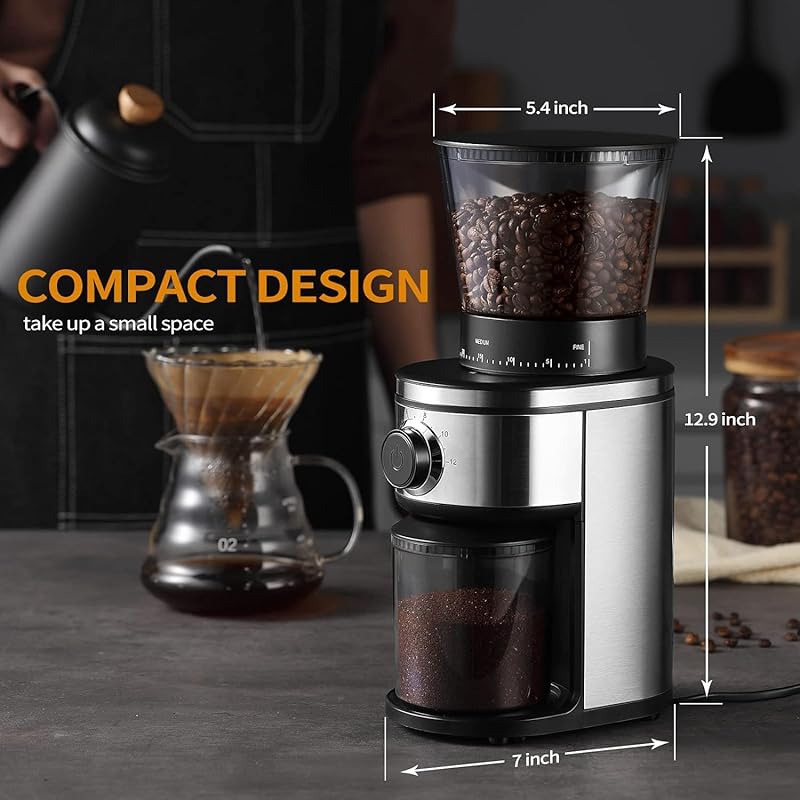
The Tuni G1 at $89.00 packs a lot into a compact frame (7.08 x 4.52 x 14.0 inches). The patented 40mm conical burr system with 450 RPM low-speed grinding minimizes static and heat. The LED touchscreen is uncommon at this price point and makes grind time adjustments easy in 0.5-second increments up to 40 seconds.
With 48 settings, a 250g/8.8oz bean hopper, and a 75g/2.6oz grounds container, it handles everything from single espresso shots to larger batches. The detachable portafilter holder fits 54-58mm portafilters. At 341 reviews with a 4.5-star rating, the Tuni G1 is a solid mid-range choice for people who want varia coffee grinder performance without the price tag. The cup-size selector (2-12 cups) adds convenience. My only real criticism is that the 40mm conical burr does not grind as uniformly as 64mm flat burrs for espresso.
Pros: - LED touchscreen for precise time control - 48 settings with low-speed 450 RPM grinding - Includes portafilter holder (54-58mm) - Compact design with large 250g hopper
Cons: - 40mm conical burr is less precise than 64mm flat for espresso - LED screen may be less durable long-term - Compact size means tighter internal tolerances
Tuni G1 Conical Burr Coffee Grinder (Silver)
The same capable grinder in a silver finish for those who prefer stainless aesthetics.
Everything about the silver Tuni G1 is identical to the ivory version above. Same 48 grind settings, same patented 40mm conical burr, same LED touchscreen, same 250g hopper and portafilter holder. The only difference is the colorway. I am including both because color preference is personal, and some kitchen setups look better with silver appliances.
At $89.00 with the same 341 reviews, you get the same proven performance. Pick whichever matches your kitchen. If you are torn between the two, the silver tends to show fingerprints less than lighter finishes.
Pros: - Identical performance to the Ivory model - Silver finish matches stainless steel kitchens - Same 48 settings, touchscreen, and portafilter holder - $89.00 price point with 341 reviews
Cons: - Same 40mm burr limitation for espresso - No functional difference from ivory version - Silver finish can show water spots
Buying Guide: What to Consider When Choosing a VS3 Alternative
Single-Dose vs. Hopper Grinders
Single-dose grinders are designed to grind exact amounts with minimal retention. Hopper grinders store beans and grind on demand. If you rotate between different coffees, single-dose is the way to go. If you drink the same beans daily, a hopper grinder is more convenient.
Flat Burrs vs. Conical Burrs
Flat burrs (like in the SHARDOR and DF64 II) produce more uniform particle distribution, which many espresso enthusiasts prefer. Conical burrs are quieter, generate less heat, and work well across all brew methods. For pure espresso performance, flat burrs have an edge.
Grind Retention
Retention is how much ground coffee stays inside the grinder between uses. For single-dosing, lower is better. The DF64 II claims under 0.1g. Most hopper grinders retain 1-3g. High retention means stale grounds from your last session mix into your next dose.
Stepless vs. Stepped Adjustment
Stepless adjustment (like the Bincoo) lets you make infinitely fine changes. Stepped adjustment locks into defined positions. Stepless gives more precision for espresso dialing but can be harder to return to an exact previous setting. Stepped is more repeatable.
Build Quality and Upgrade Path
Metal chambers and burrs last longer than plastic. Some grinders (like the DF64 II) let you upgrade burrs later, which extends the lifespan and lets you customize flavor profiles. This is valuable if you plan to grow into more advanced brewing over time.
Frequently Asked Questions
Is the Varia VS3 worth the money?
The VS3 is a solid grinder for single-dose espresso. But at its price point, it faces stiff competition from the DF64 II, which offers burr upgradability, and the SHARDOR, which provides 64mm flat burrs at a much lower price. The VS3 is worth it if you value its specific design and workflow.
Can I use these grinders for pour-over and French press?
Yes, all grinders on this list handle pour-over and French press. The ones with more grind settings (SHARDOR with 100, Tuni G1 with 48) give you more precision for dialing in these methods. Even the 28-setting OutIn Fino covers the coarser range well.
What is the minimum I should spend on an espresso grinder?
For decent espresso grinding, plan on at least $80-90. The Tuni G1 at $89.00 is the lowest price on this list that I would recommend for espresso. Below that, grinders tend to lack the fine adjustment precision that espresso demands.
How important is grind retention for espresso?
Very important if you single-dose. Retention means old, stale grounds mix with your fresh dose. For grinders with 2-3g retention, your first shot of the day will taste slightly off until the retained grounds are purged. Zero-retention grinders like the DF64 II eliminate this problem.
Should I get a flat burr or conical burr for espresso?
Both work. Flat burrs produce a more uniform particle distribution, which many specialty coffee professionals prefer for espresso. Conical burrs produce a slightly wider distribution that some people actually prefer for its body and texture. Try both if you can.
Do I need a portafilter holder on my grinder?
It is convenient but not necessary. Grinding directly into a portafilter saves a step and reduces mess. You can always grind into the included cup and transfer. A portafilter holder is a nice-to-have, especially for daily espresso routines.
Conclusion
For serious single-dose espresso, the MiiCoffee DF64 II at $399.00 is the best alternative to the Varia VS3. Zero retention, upgradable burrs, and proven performance with 318 reviews.
If $399 is too steep, the SHARDOR 64mm Flat Burr at $169.99 gives you the same burr size at less than half the cost. It is not a single-doser, but the grind quality is outstanding.
The Tuni G1 at $89.00 is my budget recommendation. The LED touchscreen, 48 settings, and portafilter holder deliver surprising value for under $100.
For portable espresso grinding, the OutIn Fino at $199.99 is in a class of its own, with USB-C charging and enough battery for 18 shots.